Written by Divya Sharma
Read moreCompassion is a lifestyle
Written by Tenzin Chonyi
Read moreA Mountain Escapade!
apricot blossoms, a note.
-Written by Rinchen Angmo
Spid is the closest possible translation of spring in Ladakhi, yet the aura that the word carries is markedly different. The word spring has this feeling of freshness. Yet when I think of the word for spring in Ladakhi, that is spid, it reminds me of the windy days in April and of course apricot blossoms. According to my Abile (granny) spid aligns with the first three months of our traditional calendar. Typically, spid is characterised by strong winds known as spid lungs or spring winds. Hence, the Ladakhi image of spring is quite different from the one that is conjured by the English word.
Read moreChil-shru: A story of five birds
Written by Nawang Chhoetso
A folktale from Spiti.
As I recall, it’s a story of five birds. But a friend of mine insisted that there were more than five birds, however even she wasn’t clear about the details. So this story will be about the tale of 5 birds.
Like all other folktales from Spiti, this too starts with the sentence ” yoyo metuk”- I don’t know what this means but every folktale starts with this sentence followed by “yul jaga chenmo na” -( in a big village). And then the story follows.
Read moreOught to know something about autumn, ya?
-Written and photographed by Rinchen Angmo
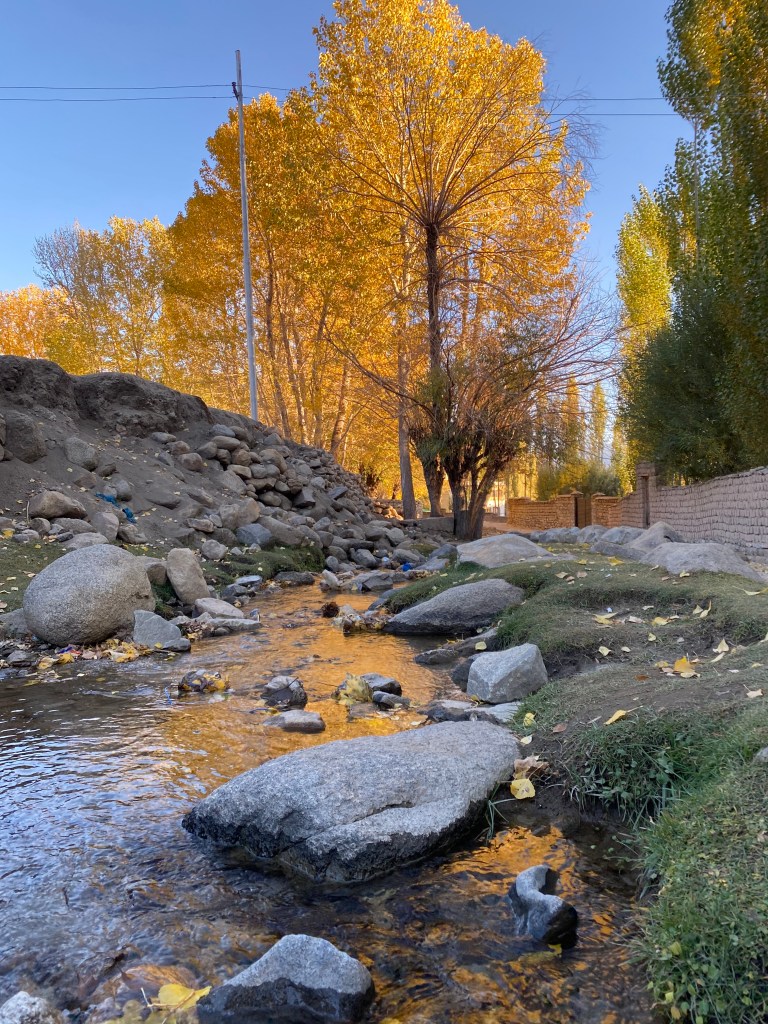
Seasons, they come and go, just like the thoughts in my mind. Even feelings come and go, but they stay a while longer than thoughts do. Yellow leaves, do they make me think of different songs?
Somehow even when I’m not in my homeland, my mind invariably registers different months vis-à-vis the seasons of my homeland. May, there will be apricot blossoms in Ladakh; June, the weather in Ladakh will be pleasant; October, the leaves will turn yellow; December, it will be very cold in Ladakh. That’s why no matter where I am, my mind always understands different months through the lens of the different seasons of Ladakh.
No Childik rang ache pula sum: A folktale from Spiti
Written by Nawang Chhoetso
“No Childik rang ache pula sum”-Brother Childik and his three sisters
It is probably my favourite tale, which was often narrated by my grandparents during my childhood before going to sleep.
It always starts with the sentence, “Ache pula sum la no chichik yotuk” i.e. three sisters had a younger brother named Childik.
Childik is a very unusual name as no one in our region has such a name. I am not sure if this name has any meaning. Maybe errors in oral traditions over several generations resulted in a name like Childik, or maybe it’s a word that we lost over the generations.
Although there is a word “Chikdil” in Bhoti language that means unity.
Recalling memories
The History of Bodyig (Tibetan script) and its current state in different regions.
Written by Rinchen Angmo.
The Bodyig script was created owing to the vision and foresight of one of the greatest Tibetan Kings, Chogyal Songsten Gampo, the 7th century ruler of Tibet. The King realized that the advancing kingdom of Tibet would soon require its own script. Chogyal Songsten Gampo sent his intelligent minister Thonmi Sambhota to India with fifteen other young Tibetans so that they could learn Indian languages whereby they could develop a script for Tibet. On Thonmi Sambhota’s return from India, the Tibetan script was finalized.
Bodyig also known in some regions as Bodhik or Bhoti, is the script that became indigenous to Tibet, Ladakh, Lahaul (sTod valley), Spiti, Bhutan (Dzongkha), Baltistan, Sikkim (for Bhutias) and other regions. However, the usage of the script is slowly waning in many regions.
Read moreA beautifully surreal month.
Written by Rinchen.
I would like to begin by thanking His Holiness The Dalai Lama for blessing and bringing so much joy to all the people of Ladakh. Chhaksal.
Each day of His Holiness’s presence in Ladakh has been filled with beauty and wonder for each and every Ladakhi in so many different ways. His Holiness’s interfaith visits, secular teachings, religious teachings, visits to Zanskar and Lingshed, and the various functions that were hosted in his honour, brought blessings upon and joy to a countless number of beings who had the sode and sonam (luck and merit) to be in His Holiness’s presence. We Ladakhis are truly honoured to have had His Holiness visit Ladakh as his first destination since the pandemic broke out.
We will miss all the beautiful moments that His Holiness’s visit brought and now look forward to His Holiness’s visit next year.
Read moreBus of Life.
-Written by Rinchen.
Hustle- the name that the 21st century gives to life.
Yet, somehow in some corners of Ladakh, people are willing to give and not just get.
Read moreWandering Watze.
A red fox on a full moon’s night.
Written by Rinchen.
My dog’s more aggressive-than-usual- bark got me to peek out of the window. A pointed snout, bushy tail and thin body.. behold the Himalayan Red Fox (known as watze in Ladakh) glimmering under the full moon’s radiance. From its body language, I inferred that it was a frequent visitor. As at any other occasion, I wondered what it meant..symbolically that is.
Read moreStone breaking ceremony and Buchens of Spiti
– Chemi Lhamo in conversation with Tenzin Sonam
Read moreSalchowk and Thultan (as named in sTod, Lahaul valley):
- – Sonam Chhomo
In the areas of Lahaul, Spiti and Ladakh, Tibet, Bhutan, Sikkim, and possibly Arunachal Pradesh, we have these traditional styled tables and mattresses in living rooms that are indigenously connected to our communities.
Read more