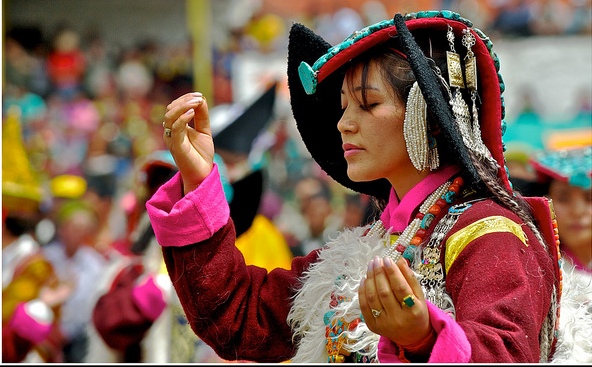
– Chemi Lhamo in conversation with Tenzin Sonam
Read moreSalchowk and Thultan (as named in sTod, Lahaul valley):
- – Sonam Chhomo
In the areas of Lahaul, Spiti and Ladakh, Tibet, Bhutan, Sikkim, and possibly Arunachal Pradesh, we have these traditional styled tables and mattresses in living rooms that are indigenously connected to our communities.
Read moreAngchok 1
a reverie?
-Rinchen
To my Abile (granny) the 2 day long Chemrey Angchok Chham (religious masked monastic performance event) was more about tending to guests in her bustling house. She recounts how our ancestral house would be full of guests, mostly relatives from outside Chemrey (our village). Chhang (Ladakhi beer) and traditonal barley and meat assortments would flow in plenty and Abile would be busy organizing rooms and food with the aid of helpers.
Read moreA tale of two tilens, two scripts.
-Rinchen.
“So Abile (granny), do you know how to read both Bodhik and Urdu?”, I asked in awe.
Abile’s answer was in the affirmative. She was telling me about her Urdu teacher when I asked her whether he was a Muslim. She said yes and that Sir Rehman le also taught Bodhik brilliantly.
Read moreShungma
By Sonam Chhomo

Shungma, Jispa, Lahaul valley
The experience of visiting places you always wanted to see for yourself is ethereal. The journey to this shungma felt almost as if I had been divinely allowed to enter its doorstep after many years of waiting for the perfect opportunity to unfold. As a child, I resisted visiting places at high altitudes because Lahaul was/is not a weather friendly place especially during the winter months. Even this time (it happened after a day), my ears remained blocked and my body felt uncomfortable for about two days.
But this year I felt as if I accomplished something.
Read moreHolding one’s own in rural Ladakh.
-Rinchen.

I read a beautiful article this morning in The Hindu’s Sunday Magazine. During the pandemic, I like many others, have found great solace not only in nature but also in learning about nature. The article’s author had written emphatically about planting the right kind of trees in the right region. The author also pointed out the harm of planting trees in areas that are not natural havens for trees: open natural ecosystems (ONEs); Ladakh being an ONE.
In recent years, Ladakh has witnessed various environmental measures, but do we understand whether they are ecologically sound? I for one, honestly don’t pretend to understand, but I do know that not everything that we think is good for nature is good for nature; that not so incidentally applies to our own well being as well.
Read moreLOSAR 2021
By Rinchen Angmo, Nawang Chhoetso and Sonam Chhomo
Read moreSocks: Can these material entities have an origin?
No place like Rangyul Ladags
-Rinchen Angmo

This land so dear to me
The only aspect that inspires true meaning before the meaningless I
Rangyul Ladags
Read moreA reflection of the reflections about the Chhorten at Leh Palace
-Rinchen Angmo

There’s something very interesting about the Chhorten wing (side) of the Leh Palace. The balcony which provides a path for skora (cicumambulation) around the chhorten presents a world in itself. On one side stands the majestic Leh Palace, golden in the light of the setting sun. While Old Leh Town tumbles beneath in all its crooked beauty. And beyond that lies Leh city, an urban landscape. We often venture to remote parts of Ladakh to find beauty, but in our very own Leh are remnants untouched by urbanity.
The acceptance of the dual name system in Lahaul
Tracing Ladakh’s History through its Dynasty.
With reference to ‘The History of Maryul Ladakh’ by Tashi Rabgias (Meme le).
-Rinchen Angmo

The history of Ladakh is a beautiful past of a people similar in some ways and diverse in others, of a land that celebrated all sentient beings, a land of Dharma but also a land that accepted every form of spirituality, a land where good will was and hopefully still is valued above gold.
Read moreHistory of Lahaul
– Sonam Chhomo
Lahaul has been the centre of two flourishing Kingdoms- the Ladakh kingdom in the north and north-west and later the Kullu and Chamba kingdoms in the south and south-west, overtime giving the people a space to form their amalgamated version of local cultures. The exact history of these regions, as Nawang states in the earlier essay, is difficult to establish pertaining to the lack of efforts in documentation in these regions. Similarly, Lahaul in the eyes of a tourist is seen as one combined valley but in reality is divided into different cultural zones within the same valley. Customs, traditions, Gods and even languages are separately defined for each valley within the entire Lahaul Valley.
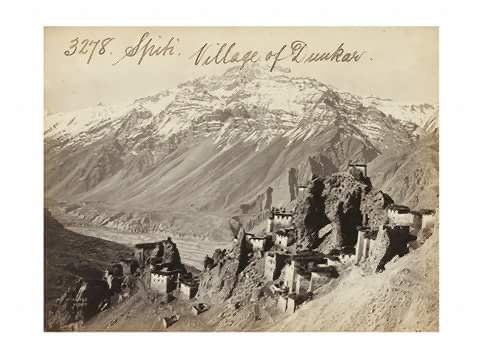
Read moreHistory of Spiti
-Nawang Chhoetso
This is a brief history of Spiti, always under a different ruler but its people never suffered. Or may be from what I have seen and observed, the people of Spiti have an amazing ability to endure unpleasant situations.
Nawang Chhoetso

“The smaller the unit less known is its history” said historian Luciano Petech .
As a kid I always wondered about the history of my place. Spiti is a barren yet beautiful land that was always isolated from the outer world. Only recently -.i.e. in 1993- did the government allow tourists permits to Spiti Valley. The place then received tourists from around the world and from India. Some travelled and went back appreciating the beauty of the valley, some were astonished by its culture. While few wondered about its history.
Read more