How is Zanskar seen from different perspectives- students who left their land for better education, families who migrated from Zanskar a long time ago, and a film that captures a remote Himalayan village?
—-Written by Sonam Chhomo Photographs sent by Anushka Kashyap Film pic taken from Lonely Planet
To my eyes, my ancestral house in Lahaul looked as if it sat atop a hill/mountain. After climbing a few jagged steps made of stone, we entered the balcony and saw huge mountains overlooking (and overpowering) the house in which I lived, for one day. My parents, being outrightly critical of their surroundings, once fell into a debate asking ‘Whose home was more beautiful?’ By ‘home’ they never meant the house but the land in which they were born or the landscape of the mountains. The debate had no conclusion. Her hometown was indeed beautiful; situated in a valley, surrounded by green-cover mountains at a correct distance from her ancestral house. My father’s hometown (the one where I went) was indeed different from my mother’s home; huge mountains with less green cover, the surface color of those mountains glistened like a mix of sand and grey hue when the sun’s rays penetrated during peak, afternoon hours in summers. It was a different kind of beautiful, I think. But in my mother’s words, sometimes it felt like a fortress with a narrow road to help us escape from suffocation. [Could mountains produce suffocation? I don’t know, perhaps the ones who have lived all their lives in those mountains might give us a clue. For them, those very mountains were home.] My father would then bulge in with his responses, yes Jispa is open, you will like it there. From Jispa, the only other open, beautiful space is Zanskar.

Picture credits- Anushka Kashyap, a traveller
When Rewasum was established, it was my ardent wish to open up a platform for writers/storytellers from Zanskar valley. The platform is open but as of now we haven’t received any response from the people of that valley. I’d rather say I did not come across found anyone from Zanskar valley in my college, and haven’t in my university yet.
Zanskar is, sort of, romanticised by my family for we consider it to have preserved pristine nature, with open roads and fields and an abundance of yaks. The people are Buddhists and some of its centuries-old communities do not engage with outsiders. Zanskar has also been part of our genealogical tales for some of us consider ourselves to have arrived from Zanskar. With all the elderly people I have spoken about Zanskar have told me ‘Zanskar is really beautiful’ ‘Like no other place on Earth’ ‘Better than our arid place’. My father once told me about two brothers from a nearby village who used to travel to Zanskar to gain some money. He now says ‘Can you imagine them now, traveling for days with mules and sheep as their companions, crossing high-range mountains and then reaching Zanskar?’
Zanskar is not a land anymore, it is now a metaphor for untouched beauty and one of the few remaining pure Tibetan Buddhist spots in the world. It is this metaphor that keeps me wondering ‘What will happen when we bring development to it?’ In today’s time, we lament for its future ‘Zanskar will not be the same anymore’ or worse ‘Zanskar will be like Lahaul in another ten years’.

Picture credits- Anushka Kashyap, a traveller
A tunnel is already under construction from the side of Lahaul valley. In recent times, the climate consequences of our developmental plans are already damaging the lands of high-Himalayan regions. Cloudbursts, melting of glaciers etc are making these places dangerous to live in. In the textbooks, we lament about the climate crisis. In rallies, we urge each other to lessen our carbon footprint. But what about the people who live there, how do they cope with such changes?- the vanishing snowslopes from the mountains, the fluctuating numbers of insects and new diseases that were non-existent before, and the sudden requirement to be wary of new changes.
It is quite possible that my/our anxieties most probably would never be seen in the same light as the urbane concerns would. This is where the film ‘Lunana: A Yak in the Classroom’ comes to rescue not just Lunana but also other remote villages in the Himalayan regions in other countries like ours. Directed by Pawo Choyning Dorji, this Bhutanese film captures the Himalayas and its people impressively. The film seems to show how similar are our struggles with climate change, terrain and our right to basic facilities such as education. The cinematic language in this film is abundant with beautiful snowlapped mountains, yaks and even the sounds of nature, with simulataneous commentaries on urban and rural divide, ways of living, our misunderstanding of the term ‘happiness’. What Ugyen, the protagonist achieved was not just teaching but instilling hope in the villagers and students. It was about rediscovering new ways of teaching that made sense to the students living there. From the film, what really struck me were the inclusion of practical inputs of classroom teaching in remote lands. For example, one scene depicted the curious faces of students as they gauged their eyes at the word ‘car’ on the blackboard. They had never seen a car in their life. How could they be expected to learn a word which did not have any sense in their language/culture? What also stayed in my mind after watching the film was the journey from Thimpu to Lunana.
It reminded me of the stories of journeys undertaken by my students from their school (Himalayan Buddhist Cultural school, Manali) to Zanskar. ‘Sitting on a mule for hours with barely any lodge to rest on the narrow slope’ was how one of them had described his story.
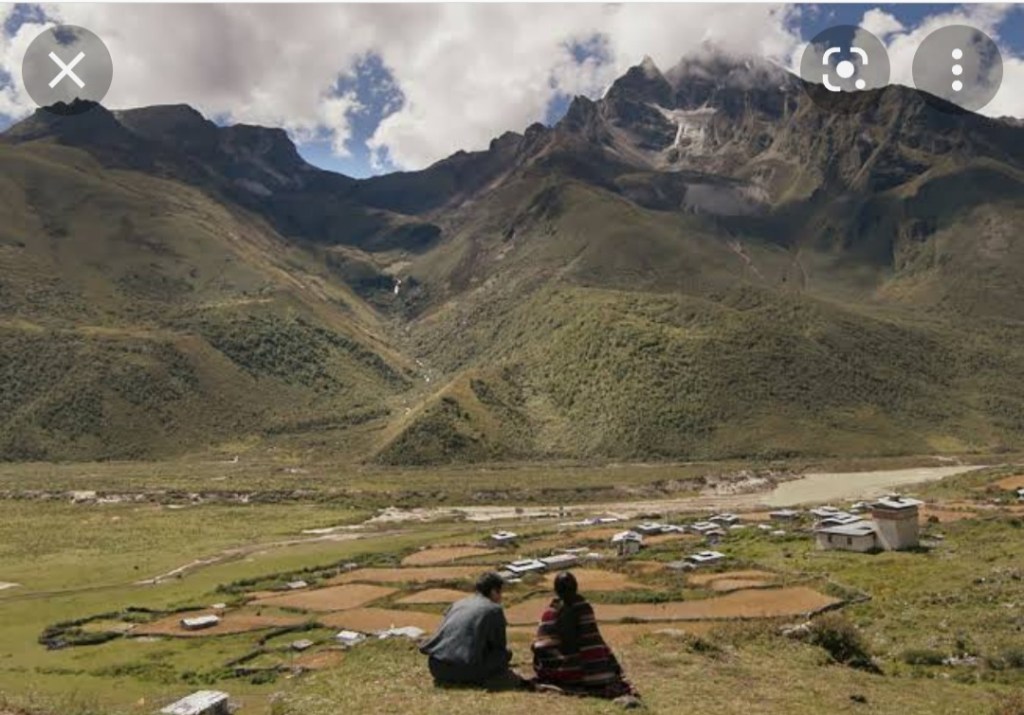
Picture credits- Lonely Planet
The end of the film was expected; he went away to another country in the illusion of finding his happiness. In the midst of a performance, he pauses and sings ‘Yak Lebi Lhadhar’ in front of the foreign audience. From his expressions, it felt like he had finally learnt how to sing the song from his heart. He was no longer singing for them, but as an offering to Lunana, the village that changed his attitude towards life.
Ugyen reminds me of someone, someone who left his hometown in India in order to earn better. He visits his hometown during holidays. Like a tourist, he sits for 10 days only to return the next year. He doesn’t sing but searches for songs like ‘Ama Jullay’ on youtube or other social media sites. Ugyen reminds me of my students whose faces glowed when I allowed them to search for their home on google images. Perhaps, it was because those google photos were the closest they could be to their home during non-vacation days.
