By Sonam Chhomo
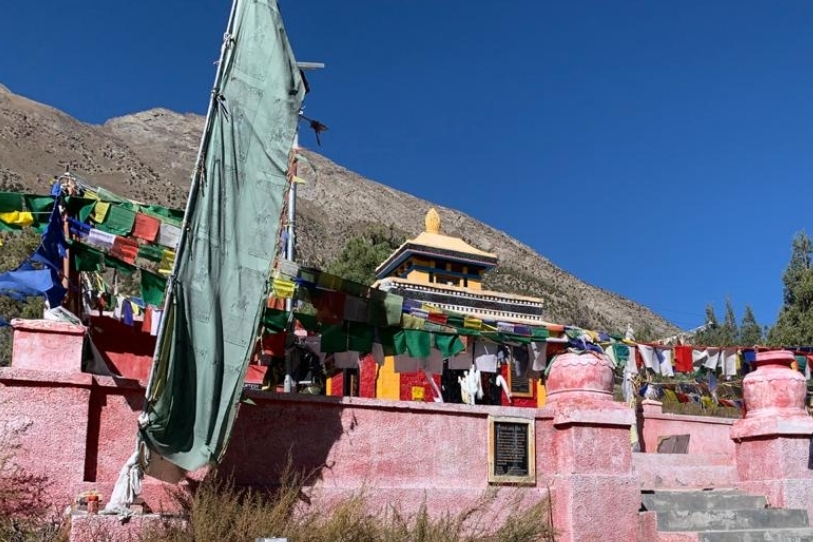
Shungma, Jispa, Lahaul valley
The experience of visiting places you always wanted to see for yourself is ethereal. The journey to this shungma felt almost as if I had been divinely allowed to enter its doorstep after many years of waiting for the perfect opportunity to unfold. As a child, I resisted visiting places at high altitudes because Lahaul was/is not a weather friendly place especially during the winter months. Even this time (it happened after a day), my ears remained blocked and my body felt uncomfortable for about two days.
But this year I felt as if I accomplished something.
The air was pure, the sky was clear of any clouds and the wind was terrifying to a certain extent. The wind could be deciphered by taking a good look on the flags on its entrance, by the flapping sound of cloth and the gushing sound of the wind itself.
The shungma that caught my fancy this year is a few kilometers away from my village on the land called Jispa, the land of campers (a name bestowed by yours truly). This shungma is a sacred site for the villagers as are all those deities in the entire state of Himachal Pradesh.
“What is a shungma?”, I asked after a few days. A shungma, as my father described, is a protector of land or village. We can find shungmas all around Lahaul, even Himachal Pradesh with different names and significance.
For those who are unacquainted with such a culture of shrines/local deities on almost all tracks of land, here is an explanation. There are certain lands in villages/areas that are dedicated to the local deity. Not any land that can be bought but a land that is held by a deity as if the deity was a living person! In Lahaul, the valleys comprise of both Hindus and Buddhists and as a result have plenty of temples dedicated to both of these religions. But there are also certain deities who may or may not fall into any religion and are thus worshipped/held sacred by the people of the land/village. Thus, you’ll find deities who belong to a certain village and are then esteemed as protectors of the land. For instance, in Lahaul valley, Ghepan is a local deity who is venerated to the point that the deity is given the title ‘Raja’ meaning King and is worshipped by all the people belonging to Lahaul valley. He has a similar shrine/temple in Sissu, the village of the deity.
Similarly, the shungma that I mentioned in the beginning is dedicated to the deity Dorje Lakhpa in Jispa.
There are two shrines, the recently built shrine is the one situated on the upper side of the highway road. On its left side is a shrine containing a large prayer wheel for followers to spread the teachings of Buddha. The one on the lower side of the hill is smaller and much simpler than the upper one. It has nothing decorative inside, it is just adorned with prayer flags all around the white colored structure beside an old tree. This juniper tree is sacred and is said to be age-old. A tree which does not die. A tree which has stayed at that place for a long, long time.
The deity is rather said to be an angry one; the name itself refers to the deity who weilds a weapon/shastra on his hand. When I searched on the web, there was no mention of a god but a mountain in Nepal which bears the same name. I wonder if it is connected or just a coincidence. Whatever the reason it adds to the mystery surrounding the deity in this region.
There is one story that I came across a few years ago. Initially, there were no such entrances or clear indication of the shungma on the highway road. And it is said that many trucks/cars would fall over the cliff or slide over. After many such incidents, the BRO realized and recognized the power of a supernatural presence. They didn’t post on social media about this recent declaration like how everyone usually does these days. Instead they built a pedestal (to offer incences) to commemorate the presence of the deity.
___________________________________________
If there are any more stories that you have heard about this deity or any other deity, then we would love to hear it from you.
You can either mail us on our address rewa.snr@gmail.com or comment on instagram/wordpress.
