-Sonam Chhomo

Lahaul valley, also known as Garzha, is surprisingly one of the areas where the Moravian missionaries had undertaken explorations to understand its people and culture (also to spread christainity perhaps but could persuade only one). It is through their works that many anthropologists and historians have written and referred to in the history of Lahaul valley.
In addition to anthropological works, the people of the valley also believe (perhaps true but never written down) that the Moravian missionaries were helpful in introducing/advancing innovations on some already existing skills of the community members.
First was the introduction of potatoes in the area and the second, the lesser known, is the hand woven woollen socks that are nowadays easily found in shops selling shawls and other woolen products in Himachal Pradesh. To all that is known this material also has an origin and migration development.
Historically, it had naturally existed in its precursor form- as simple woollen material worn by its people to protect themselves from the harsh, cold winter. Although not much is known about it, for example who were the earliest ones to make it, what was the earliest design or was there any design at all, but still as little as we remember it, the encounter with the Moravian missionaries supplemented the villagers with another product to trade along with salt and wood from the forest area. Thus, this woolen socks-making activity became an everyday means of livelihood for its people, which still exists till date for many villagers! In the past, It was generally knitted by the women of the family who used wool from their own stock of sheep and cattle, which also ensured warmth for its wearers. However, in recent years the women folk from the community use market wool in order to knit their socks in new designs, shapes and colors (still warm, but not that much ;o;)
In recent years, this communal practice of sock-making activity has found its way into the homes of Spiti valley and in Kinnaur and now this activity can be largely found among the women communities of these three tribal regions of Himachal Pradesh. Thus, in every sense of this history, this art form can also be designated as an indigenous art form!
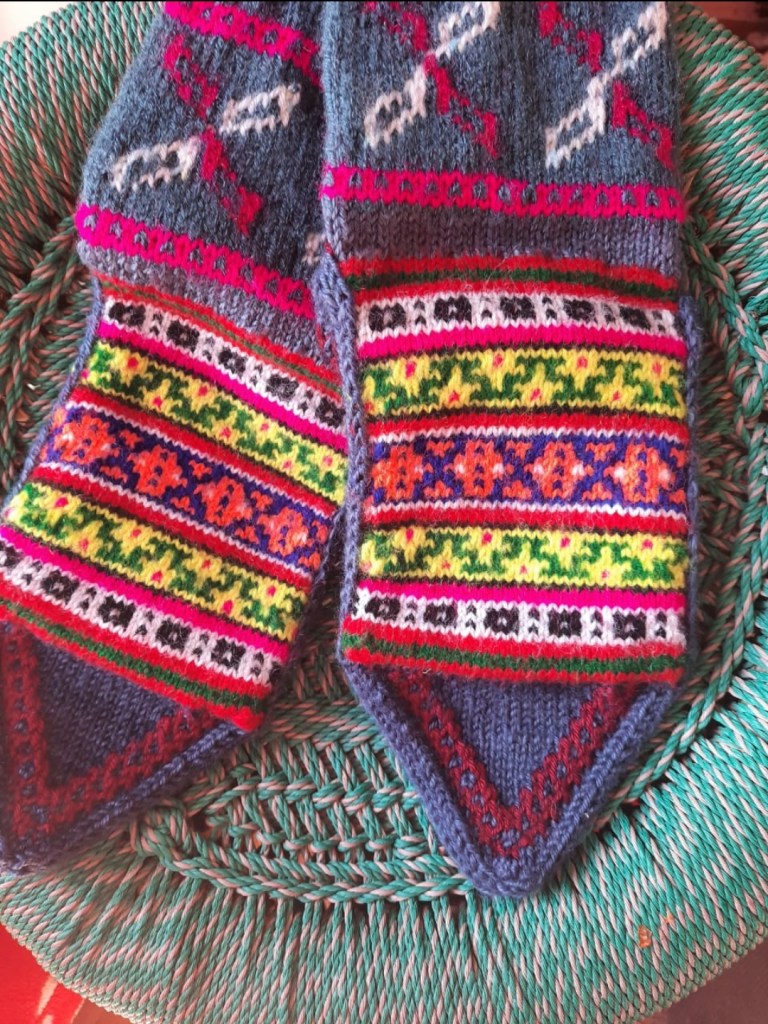
The designs are intricately knitted into these socks and stay consistent in nature, such that we can say that these designs are passed down as legacies from one generation to the next. But I haven’t been able to find the meaning behind these designs. Some people say that it probably means nothing or probably the women folk found it easier to knit these into socks. Some others believe that it must be the wave of Buddhism that could have inspired them to knit similar looking, less- complex versions of Buddhist symbols of an endless knot. What are your ideas about it?
Do let us know in the comments!
.
Source: From my Father’s oral dissemination on his land.
