By Sonam Chhomo
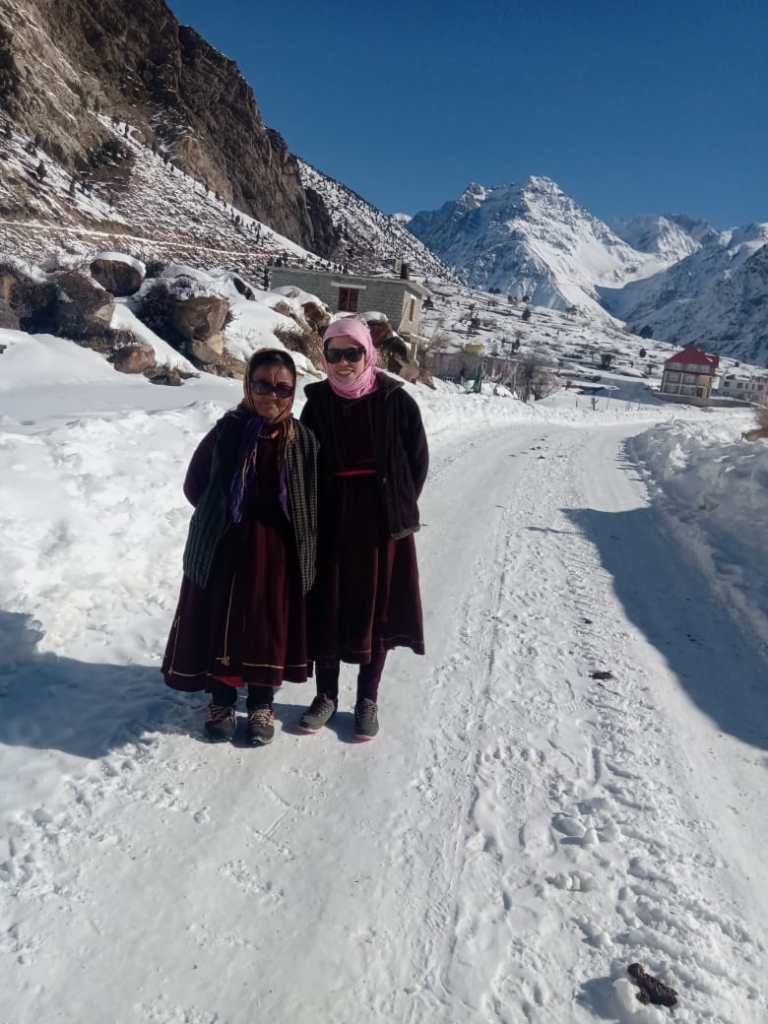
The dual name system can be seen as a product of acculturation as observed by Tobdan in his book, “The people of the upper valley (the sTodpas of Lahul in the Himalayas)”. It refers to the instances of using both Hindi and Bhoti names where the latter is used in official documents, or a combination of Hindi and Bhoti names such as Sonam Ram, Dolma Devi or in some cases completely adopting Hindi names for the next generations. It can be seen as an unconscious attempt by some people to adjust to the mainland culture. In the earlier times, the teachers in schools, who largely belonged to the Hindi-affluent areas, often gave a fresh name in Hindi to the students or transformed the original name so that it could be conveniently written and pronounced (Tobdan, 99). According to sources who were raised in the urban areas, this usage also helped them in coping with the embarrassment or teasing of their names in schools, colleges and work-related spaces.
This system can be seen through the lens of history too, where this system was first adopted by the ruling class (Khar) families of Lahaul. According to the genealogical document with approximate dates based on data and those given by Masse and Francke of the Khars of Khangsar, it can be noticed that the Hindi names ending with Chand began from 1790, almost a century after the Kullu king Parbat Singh had gained authority over the local rulers (Khar) of Lahaul. There is even an adoption of both Bhoti and Hindi names of the next ruler, ‘Tashi Angta or Dharam Chand’ c. 1815-1840. (Tobdan, 26)
The situation for the ruling families must have arisen due to the different political systems and cultural and religious history. In order to show their allegiance and facilitate easier interaction, the ruling families changed their genealogy to show that they descended from the Rajput clans, were worthy to rule and thus referred themselves as Thakurs by outsiders and eventually locals too. But they had no evidence to support it because it never truly was the case. Instead, the book claims with supporting documents that some of the ruling families had their rus (family bone) similar to the rus from Zanskar and Ladakh. Their settlement in Lahaul particularly stood isolated, which on one side gave fruition to an amalgamated form of culture and on the other hand, faint notions of caste system started permeating into the usually casteless society. (note should be taken that sTod region of Lahaul follows a different social stratification from the other lower valleys of Lahaul)
.
In the time period when Nangpa or the common population began their education in Kullu, they were compelled to identify with a similar caste which achieved the characteristics of their occupation at home and at the same time did not procure any deviant behaviour from the Hindu societies. This tendency was particularly seen in schools where the official documents demanded this kind of information.
Tobdan explains this instance of a local student in Kullu who was as confused as any other person from Lahaul about the unfamiliarity of caste, surname and language.
“It would not be inappropriate to describe here to illustrate the above fact, how Remba discovered the word ‘rajput’. He was studying in a school in Kullu when some officials came to school and began recording various kinds of information about the students. As the students proceeded to line up in a queue, Remba asked his friends who were done with the answers, as to what they were asking inside. They replied by saying, ‘they are asking the same ace perplexing question, among many others.’ The reply that was given to them were Rajput, others Brahmins, Koli, Harijan etc. he enquired from another boy who also belonged to Remba’s district who told that ‘Rajput’ would be an appropriate answer. Remba thought that that might be the correct answer as he neither belonged to Brahmins nor Harijans. If he gave an answer in his own language, nobody will understand it, rather he would become a laughing stock for the questioners. The illiterate villagers learnt about the word in similar circumstances. At times, they were helped by the employers themselves.” (Tobdan, 42)
.
The people belonging to the Nangpa class were referred to as Kanets before independence, particularly used by Alexander Cunningham for the first time. Later, after independence they were given the name ‘Rajput’ by the scholars but the population on whom they refer to in their case studies were oblivious to such names. The question of asking a caste is nonsensical when it comes to people belonging to a relatively casteless society. When the schools and government papers demanded such unethical answers, the only way to fulfill this requirement was how Remba solved his situation.
The present generation might be using both Hindi and Bhoti names or are adept in referring to themselves by their Hindi names. In some ways, it feels lighter to know that this change in the cultural alignment had been sown in the minds of the people for a long time. Perhaps, the only way to resist this cultural appropriation is by becoming aware of it. For many people I know from Lahaul, we are mostly unaware of how much of our cultural insecurity is rooted in the way our ancestors were treated by the majoritarian culture. By observing this conditioned behaviour, it is inevitable that conversations around such cases were less and lesser conversations certainly mean that the future generations are born almost defiant to their own culture. By knowing our origins and history helps in carving our own identity among dominant cultures such as the case found in many urban areas. It is completely understandable that sometimes our Hindi names are much better in creating a bubble for us, but there is always a part of yourself which is hidden away purposely and this realisation just throws you in a pit, a black pit sometimes. And many times, you emerge out of it only when you have accepted yourself completely, which in some cases might refer to your culture, your name or your language.
So HAPPY LEARNING. I hope one day we become really proud of who we are!
.
Source: Tobdan, “The people of the upper valley (the sTodpas of Lahul)”, Book India Publishing co., Delhi, 1993
