-Nawang Chhoetso
This is a brief history of Spiti, always under a different ruler but its people never suffered. Or may be from what I have seen and observed, the people of Spiti have an amazing ability to endure unpleasant situations.
Nawang Chhoetso
“The smaller the unit less known is its history” said historian Luciano Petech .
As a kid I always wondered about the history of my place. Spiti is a barren yet beautiful land that was always isolated from the outer world. Only recently -.i.e. in 1993- did the government allow tourists permits to Spiti Valley. The place then received tourists from around the world and from India. Some travelled and went back appreciating the beauty of the valley, some were astonished by its culture. While few wondered about its history.
Being an isolated place, education reached here very late. Thus, Spiti never had historians to write its history. All that we know today regarding the history of this valley is mainly sourced from what we hear from our elders .i.e. the oral history that passes from generation to generation .This article has been sourced from the research file of Tashi Tsering ,student of The University of British(Vancouver),Yannict Laurrent (Wolfson college ,Oxford) and from the book “Spiti: Adventure in the Trans-himalaya” by Harish Kapadia who has always loved Spiti. Also, my Late grandfather Padma Dorje who was always curious about the history of this region and had a lot to say about it.
According to some Tibetan sources, it’s said that before 7th century AD Spiti was ruled by the ZhangZhung kingdom; though this cannot be accurately verified. Between 7th to 9th century
AD the expanding Tibetan empire took Spiti under itself. The influence of the Tibetan empire can be still seen in the administration system of Spiti. For example, in Spiti there exists the Khangchen system. Khangchen refers to the household that possesses the major share of the land in the valley. Households in Spiti are mainly divided into two categories: Khangchen and Dhutul. Dhutul are the landless people or people having small shares of land. It’s said that earlier there were 250 Khangchen in Spiti .These families had to pay tax to the Tibetan ruler. Along with this they had to send one member from each family to serve as soldier when needed by the Tibetan emperor. Some of these families still possess the traditional bow and arrow.The same system of administration was prevalent in many parts of Tibet.
From late 10th century AD the rising kingdom of Guge took Spiti under its expanding kingdom. During this period began the second diffusion of Buddhism. The great translator Rinchen Zangpo was sent by the king of Guge to Kashmir to study Buddhist texts and translate them from Sanskrit to Tibetan. On his way to Kashmir, Great translator Rinchen Zangpo built many monasteries in regions including Spiti, Kinnaur, Ladakh and Zanskar. Buddhism was fully accepted in Spiti.
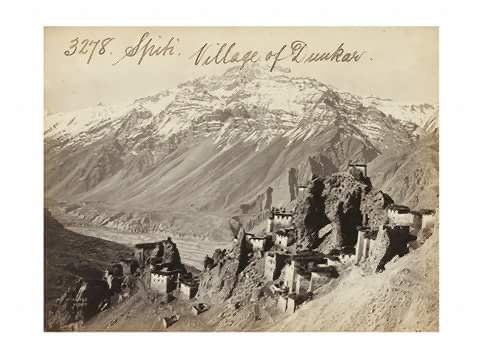
But after the end of Guge kingdom,the fate of Spiti was always linked with its powerful neighbour. It’s believed by the elders in Spiti that Spitians rarely fought any war as the inaccessible area was easily defendable. Morover, Spiti was never a target for any invader . After the end of the Guge kingdom, many invaders ruled Spiti, but the life of Spitians was never effected as not much attention was given to this small barren land. Around 17th century Ladakh rule established in Spiti. After death of the Ladakh ruler Namgyal, his third son got possession of Zanskar and Spiti. But Spiti was loosely ruled and they didn’t make significant changes in its administrative system. The king rarely visited Spiti and major authority was given to Nono. It was Nono’s responsibility to collect taxes from the Khangchen households and he had backing from Ladakh. For the people of Spiti, Nono was their king. Even today they are highly respected. Earlier Nono used to live in Dhankar the ancient capital of Spiti but later they shifted to Kuling (earlier known as kiling)due to better weather conditions and people also say that back then Kuling use to be a very beautiful as its name(Kiling) also translates to “happy place”. Thus, since then whoever invaded Ladakh ,Spiti went under that ruler.
General Zorawar Singh invaded Ladakh and Spiti along his way to Tibet between 1834- 41. He appointed Rahim Khan as in-charge of Spiti. His son-in-law Gulam Khan looted Spiti. It’s said that it was the first time Spiti faced the wrath of any invader. Zorawar was defeated by the winter army of Tibet ,and his kingdom was disintegrated. And Spiti went under Ladakh again. Since then until the arrival of the East India company, Spiti was mainly under the ruler of Ladakh.
It was then during the rule of East India company .i.e. 1846 British East India company took Spiti under itself. Spiti was like an alien land to them but they thought it woud be inadvisable to consider Spiti as an alien land because Spiti was connected to rivers and also the major wool producing district of Ladakh .i.e. Changthang. That same year the British government fixed the boundaries between Spiti-Ladakh and Spiti-Tibet. Spiti was given to the Raja of Bhushar to rule. Spiti was never the main source of revenue thus they didn’t make too many changes in its administrative system. In 1864 the reigning Nono of Spiti died. The British took this as an opportunity to reduce the power of Nono. Thus, a set of rules were framed to reduce the power of Nono.
During British rule, a special person was appointed in Spiti called Munshi who used to be the translator for them. During my childhood when I asked my great grandmother about the period of British rule she said that, “They were never rude to us .They never bothered us ,so neither did we.” To this she also added that it was fascinating to see white people. Whenever a British man visited Spiti they would rush to just see him. Though I am not sure whether she was bluffing or was serious.
With Indian independence, Spiti became a part of the Indian republic. During that period Spiti was part of the Kangra district and Lahaul tehsil. The capital of Spiti was changed from Dhangkar to Kaza the land in the valley plains. After few years Spiti received attention. Schools were built ,teachers were sent from plains. Police services, banks and other government facilities were provided. And luckily my grandfather and his friends got to see school doors. Some who could afford it even went to study outside for better education.
In May 1957, the election of India’s President took place.Spiti had two seats under each category allocated ,thus the court ordered to conduct elections in this valley. This was the first ever democratic process in this part of the world.
In 1962 during the India- China war, there was no war on the Spiti border but defence forces reached Spiti. Spiti was put under the inner line. The Indo –Tibetan border force still has a strong presence her. And Spiti had to bear both its positive and negative consequences. No foreigner was allowed to enter Spiti and Indian nationals required special permits. A good aspect was construction of roads. In 1966 Spiti was merged with Himachal .Till then it was part of Punjab(which is why my grandpa can still read and write Punjabi). And in 1993 the government allowed permits for everyone. Spiti was connected with the world again. Tourism started expanding. And since then Spiti has been continuously growing and adapting with the world outside, while maintaining its beautiful traditions.
This is a brief history of Spiti, always under a different ruler but its people never suffered. Or may be from what I have seen and observed, the people of Spiti have an amazing ability to endure unpleasant situations. May be the harsh climate made them immune to any other suffering. The story of Zorawar Singh says that when he attacked Spiti ,unlike other region people of Spiti ran away towards the monastery leaving their houses to burn. When I narrated this to the elders of my village some jokingly blamed the writer saying that the writer is lying, some said that , “We are peaceful people and we hate violence.” While some laughed at this and were be happy because someone has mentioned Spiti in their book.
But a very common question of visitors still remains unanswered. Why did our first ancestors decide to settle here, where the climate is harsh and life is difficult. When asked about this, the voluble people of Spiti will not have anything to say .They will be lost deep in thought. But will surely defend their valley saying, “The climate is a bit harsh and life may be a little difficult sometimes, but it’s also peaceful and wonderful.”

Really appreciate your wonderful work. You’ve done a good research . Thankyou for the effort you’ve put in. Your work will surely help many others like me , to know more about our motherland. Let’s feel proud to be born in the land of mountains 😊
LikeLiked by 1 person
Thank you so much Ache🙂
We truly appreciate your feedback.
Means a lot🙏
LikeLike