Reflections on my recent visit to Harwan monastery, Srinagar

Written and photographed by Sonam Chhomo

An aerial view of the ruins at Harwan

When I first reached Srinagar, I did not expect my relatives to suggest a visit to a monastery. Most historical narratives do not talk about Buddhist archaelogical sites in Kashmir. As part of the itinerary for the first day, we decided to see the Harwan garden and Harwan monastery. Harwan is a village near Srinagar, about 21 kms away from the city. Harwan garden is quite similar to other gardens, the dam stretching towards Dachigam. On our way back, we began our journey to the monastery.

The journey to the monastery was difficult to navigate; we had to keep an eye on a small green-colored signboard that indicated the direction to the monastery. We parked our vehicle inside a narrow pathway which led to residences and shops in the area. The monastery, as I came to know later, was up on a mountain hidden like a gem. What we saw was not just a monastery or the ruins of the monastery as I would later know but ruins of a chaitya, a structure that we deemed as a residence, and a stupa like structure. In order to reach the first part of the site i.e. the ruins of chaitya, residence, and stupa like structure, we had to climb some 200 steps/stairs. While climbing the stairs and then turning my back to look at the majestic mountains, we could clearly understand why the monks had chosen the place as their abode of living and enlightenment. We could hear the birds chirping, the wind gushing, and the chinar leaves holding their spirit still as the leaves rustled. What a perfect place to meditate! What an immense pleasure it was to revel in that silence!

Read more

New age Kinnauri weddings

-written by Karma Negi

Marriage is one of the most important institutions of any civilisation. It acts as the base of many societies. Various societies have their own rituals and customs for marriage.

And over time, the rituals and customs have evolved. In the old days, Kinnauri weddings used to happen for 4 days. But due to time constraints and other unknown reasons, marriages have now become just a 2 day event.

Read more

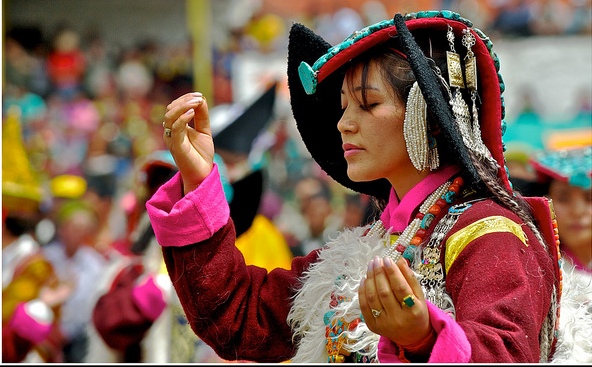
Women in Ladakh

As a child, the question of gender inequality was quite foreign to me. Of course, I was aware of differences, but never of inequality per se.

-Rinchen Angmo

Image courtesy: watsupptoday.com

I grew up in spaces that were owned either by my maternal grandmother or by my mother. I guess this statement needs a bit of a context. In Ladakh, the system of marriage is very flexible in terms of which household the bride or the bridegroom goes to; meaning, either the bridegroom could go to the bride’s house(makpa) or vice versa(pagma). ‘Going to’ the other’s house also means assuming more responsibility over that household than your own. Both in my maternal grandmother’s and my mother’s case the bridegroom had come to their house; consequently, they received an equal share of family property. This is a common phenomenon in Ladakh and has been followed from time immemorial. In fact, even the daughters or sons who depart to another household after marriage attain a small share of family property. Hence, in Ladakh, the question of whether or not a woman can own property figures as a redundant one. Why does owning property become so important one may ask.. When one sees one’s mother or grandmother as a figure who owns property, manages it with finesse, and goes unquestioned by society, one also understands that those constructs of a-woman-can’t-handle-‘manly’-responsibilities, are after-all ‘man’-made fallacies. 

Read more