By Rinchen Angmo
Someday we’ll stand in front of Singey Khababs (River Indus),
It’ll be a witness to us,
To our hopes and dreams,
To our tears and screams,
By Rinchen Angmo
Someday we’ll stand in front of Singey Khababs (River Indus),
It’ll be a witness to us,
To our hopes and dreams,
To our tears and screams,
By Manya Ohri
Read moreBy Lhundup Gyalpo
Picture this: An alpine desert forest is yet to receive its share of rain. For now, all it boasts of is an overgrowth of shrubs and thorns; dull, prickly, and urgently jostling for every nook of the forest. In a busy yet insipid corner of the parched forest, a yellow dandelion blooms silently, perky yet serene, pleasing to watch, and assuredly present.
Read moreBy Lhundup Gyalpo
Buddha Purnima, the full moon day of the 4th month of the lunar Calendar, is celebrated as the birth, enlightenment and passing away of the Lord Buddha. Of the many celebratory events that mark the day, one, in particular, is peculiar to Ladakh; the procession of Buddha’s scriptures. People carry thick and heavy volumes, usually wrapped in saffron cloth, over their heads and shoulders and tread across the rugged expanse of Leh town for almost a whole day!
Read moreBy Lhundup Gyalpo
A bunch of yellow and listless leaves rustled in a small eddy by the closed door. The wind blew in a melancholic whirl, whistling in a doleful hum. Nine thirty-two in the morning, the house was still dimly lit, bereft of light; a thick overcast kept the sun away in its sombre folds.
Read moreWritten by Divya Sharma
Read more-Written and photographed by Rinchen Angmo
Pangong Tso is so much more than a water body, it is a living remnant of natural history.
Anyone who’s been to Pangong Tso will testify to it’s limitless beauty. Glittering amidst snow capped mountains, the water body is one of its kinds. Different hues of blue adorn it’s large expanse.
Pangong Tso is not only a beautiful water body but also a living remnant of natural history. According to geography, the Tethys sea was an ancient water body that existed in this part of the world. As the two continents collided to give rise to the Himalayas, the sea was subsumed, except some bits of it which remained as lakes. Other theories trace the origin of high altitude lakes to later tectonic activities. Either way, lakes like Pangong Tso in the Trans-Himalayas are living remnants of natural history.

-Written by Rinchen Angmo
Spid is the closest possible translation of spring in Ladakhi, yet the aura that the word carries is markedly different. The word spring has this feeling of freshness. Yet when I think of the word for spring in Ladakhi, that is spid, it reminds me of the windy days in April and of course apricot blossoms. According to my Abile (granny) spid aligns with the first three months of our traditional calendar. Typically, spid is characterised by strong winds known as spid lungs or spring winds. Hence, the Ladakhi image of spring is quite different from the one that is conjured by the English word.
Read moreWritten and photographed by Rinchen Angmo
Of the few complete winters I have spent in Ladakh, in the winter of 2020-2021 I finally tried ice skating. When I was younger, I’d often been envious of ice skaters; back then, Karzu zing was the ice skating hub of Leh.
Winter in Ladakh can get dreary, but for many young Ladakhis ice skating has been quite the winter activity. However, since ice skates are expensive, it is not an activity that many can afford.
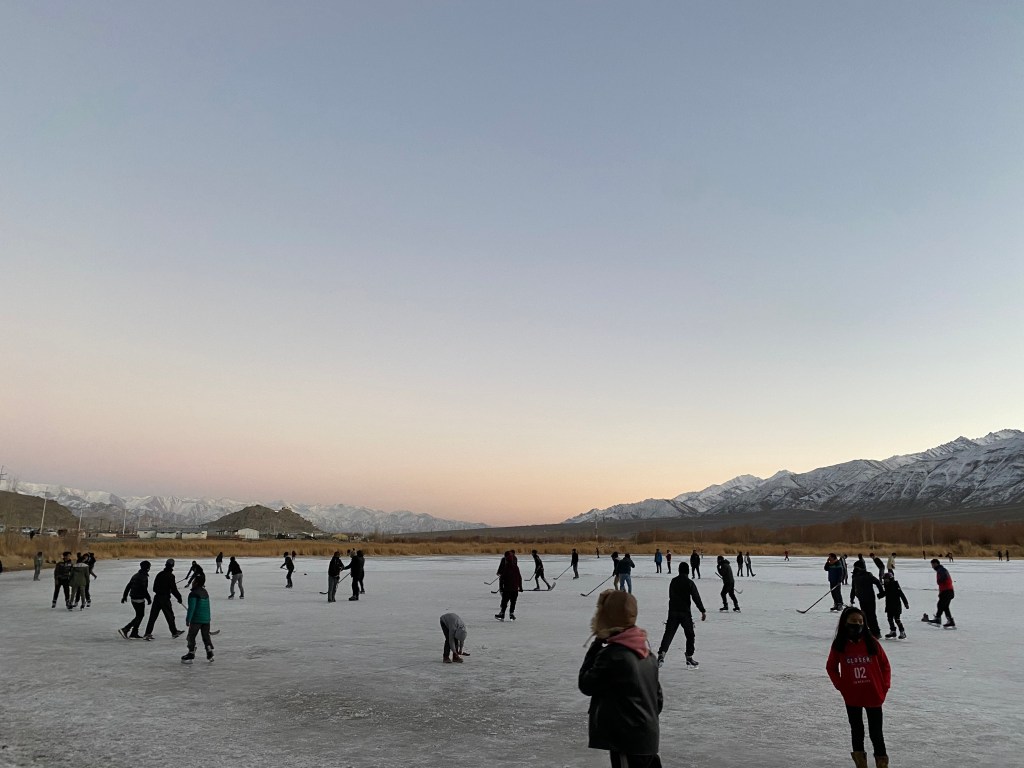
Many years back, when I came across Auden’s “Musée des Beaux Arts” I looked up the associated paintings and somehow Pieter Bruegel’s depiction of ice skaters really reminded me of the ice skating scene in Leh. I’m not sure whether or not the figures in his paintings don modern ice skates; regardless, the connection remains, because even before modern ice skates arrived in Ladakh, activities on ice like “sikiting”-skating on a small sledge like structure- were prevalent. So, it’s the overall ethos of the portion of the paintings which depict ice skating which resonated with me.
Read moreWritten by Rinchen Angmo
Nas, the food associated root of my existence. The Ladakhi word for barley is nas. For centuries, the people of Ladakh, Tibet, Spiti, Lahaul and various places across the Trans-Himalayas have cultivated barley. In most parts of the aforementioned places, a barley based dish called kholak/tsampa has from time immemorial been a staple diet.
Though I don’t eat kholak as often as I would like to, the dish inevitably becomes a symbol of the root of my food associated existence. I say food associated specifically, because there are various other ways of quantifying roots of existence in different tangible and philosophical spheres.

-Written and photographed by Rinchen Angmo
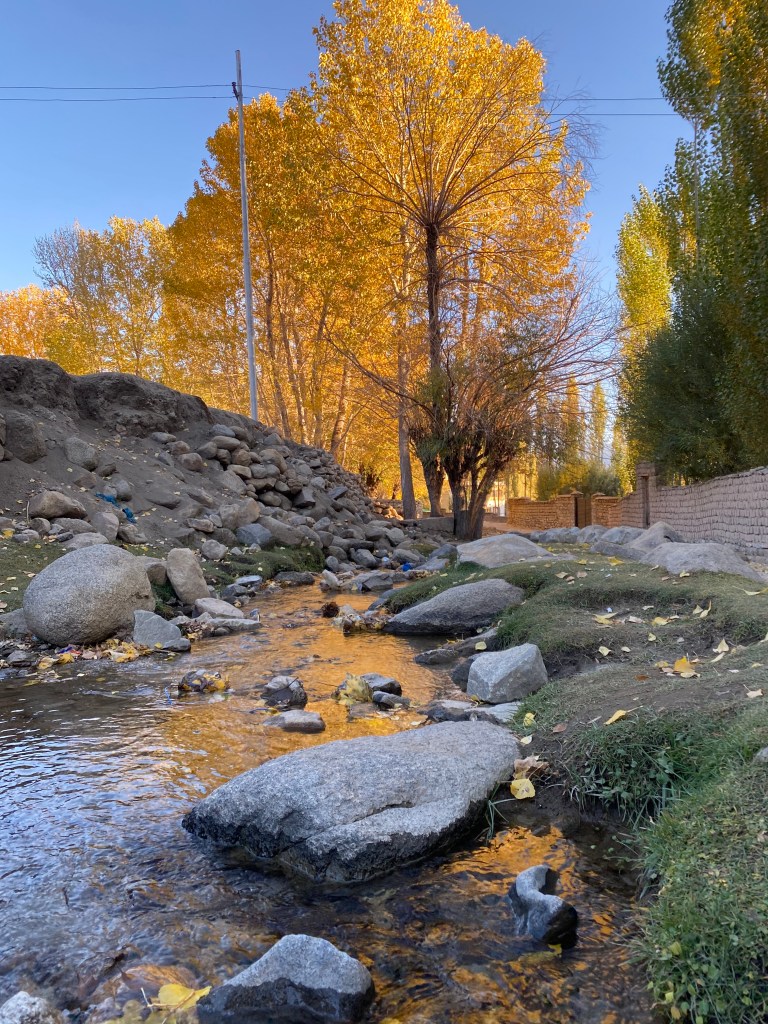
Seasons, they come and go, just like the thoughts in my mind. Even feelings come and go, but they stay a while longer than thoughts do. Yellow leaves, do they make me think of different songs?
Somehow even when I’m not in my homeland, my mind invariably registers different months vis-à-vis the seasons of my homeland. May, there will be apricot blossoms in Ladakh; June, the weather in Ladakh will be pleasant; October, the leaves will turn yellow; December, it will be very cold in Ladakh. That’s why no matter where I am, my mind always understands different months through the lens of the different seasons of Ladakh.
Written and photographed by Rinchen Angmo
The pictures in this photo essay could possibly depict the myriad microcosms inhabited by different beings within the world of Leh Main Market area. Since I hadn’t taken these with the intention of later turning them into a photo essay, would it perhaps be okay to say that there is a somewhat natural element to the pictures’ composition? A somewhat natural element that wouldn’t have been captured if not for the mobility facilitated by new media.

Anyone who has been to Leh Main Market will know that the little kids who live in the area make the market their playground: playing football, cycling, skateboarding and roller skating. Skateboarding has really taken off in Leh. In a span of a few years, I have noticed an increasing number of skateboarders. This year, I also spotted many roller-skaters; could this be a convenient way to keep ice-skating skills intact? In Ladakh, during the winters, all water bodies get completely frozen: forming natural ice skating arenas. Hence, many take to the winter sport; however, since ice-skates are expensive, not many can afford the sport.
Read moreWritten by Rinchen Angmo.
‘Tibetan Caravans’ is a book by Abdul Wahid Radhu le from Ladakh. Reading Wahid le’s book made me realize the importance of recording one’s life accounts for future generations. Since ‘History’ is often manipulated by various powers, individual stories become increasingly important. After all, it is through these individual stories that one gets a glimpse into a world that would otherwise have been forgotten, fabricated or made foreign.
Wahid le’s book assumes great significance in terms of documenting the waning days of trans-Himalayan trade as well as eye-witness accounts of the systemic attempt of the destruction of Tibetan culture and Tibetan Buddhism by the Communist Party of China in its early days of occupation. Moreover, it provides a glimpse of life in the trans-Himalayas before ‘modernization’ reached its doors.
Read morewritten by Rinchen Angmo
It is very disturbing to witness how manipulative media houses and ignorant people have the audacity to try defame His Holiness the Dalia Lama who has dedicated every moment of his life for the well being of sentient beings. It is to challenge this audacity that I feel compelled to write this. For too long we have let hegemonic forces spew venom, it’s high time we put an end to contrived narratives that deliberately spread hate.
Before I proceed I want to put forth some questions: Do you know what enlightenment means? Do you understand Buddhism? Do you understand the practices of Tibetan Buddhism? Do you understand what it means to perceive reality beyond duality? Do you understand what blessings mean? Do you understand the real meaning of compassion? Do you understand Tibetan culture? Do you understand that when one prostrates before statues it symbolizes the offering of body, speech and mind? Do understand the symbolic meaning of offering body, speech and mind? Do you understand the meaning of emptiness? Do you understand what it means to dedicate not just one, but several lifetimes for the well-being of other sentient beings?
Read more