Seasons, they come and go, just like the thoughts in my mind. Even feelings come and go, but they stay a while longer than thoughts do. Yellow leaves, do they make me think of different songs?
Somehow even when I’m not in my homeland, my mind invariably registers different months vis-à-vis the seasons of my homeland. May, there will be apricot blossoms in Ladakh; June, the weather in Ladakh will be pleasant; October, the leaves will turn yellow; December, it will be very cold in Ladakh. That’s why no matter where I am, my mind always understands different months through the lens of the different seasons of Ladakh.
There are times when I feel that I do not have a right to speak about my valley. After all, I have half a parentage from there. Since childhood, my sister and I have constantly juggled between identities that our multi-ethnic selves reflected in our facial features and body languages. If the places in which we lived commented on our not-so mainlandish features, our hometowns considered us the opposite. We looked quite different even from them. As the looks would always be an issue, I guess my family members tried looking at it from a different perspective. Instead of eyes, they would comment on how my hair resembled my aane’s. Instead of the tone of the skin, they would tell me that I behaved exactly like a Lahauli. Although I used to take these matters seriously, it’s only on reflection that I realize these were rueful complements to make me feel a part of the family, of the larger community.
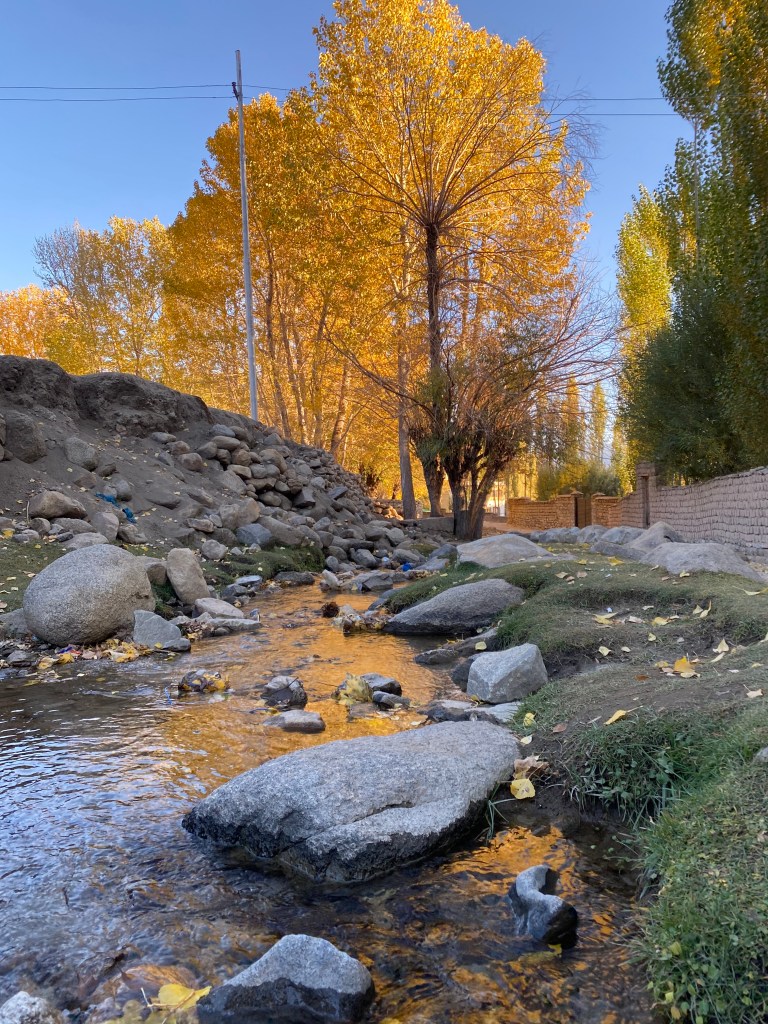
A stream that arose from a groundwater source from a hill near Garloni village. Photograph by Drishti.
It’s been fourteen days since that night when I witnessed the fields of my grandmother turn into debris. The lush green plants that used to crown those fields have now disappeared. What remains now are uprooted plants merged with soil and water flowing over them. The groundwater, surging from an overcharged aquifer, displayed a relentless determination to escape onto the Earth’s surface, washing the fields away. The night of 13th August 2023 will remain unforgettable. The fear of the unknown robbed me of sleep and caused my heart to pound. At the crack of dawn, I came out to check on the aftermath of the night. In front of my eyes lay the remains of the hard work of my guardians. Many emotions coursed through me, but the prevailing feeling was that of thankfulness for our survival. This incident had occurred when I was at my grandparents’ house near Garloni, which is about 4 km from Rewalsar town. Our phones were out of network for two days, and there was no electricity. Amid the rain, it was challenging to go out and find a spot with good network. But the urge to talk to my parents and loved ones kept me going out frequently. An old radio of my grandfather’s found a purpose after years of neglect; the news bulletin informed us that the situation in other places was much worse.
‘Tibetan Caravans’ is a book by Abdul Wahid Radhu le from Ladakh. Reading Wahid le’s book made me realize the importance of recording one’s life accounts for future generations. Since ‘History’ is often manipulated by various powers, individual stories become increasingly important. After all, it is through these individual stories that one gets a glimpse into a world that would otherwise have been forgotten, fabricated or made foreign.
Wahid le’s book assumes great significance in terms of documenting the waning days of trans-Himalayan trade as well as eye-witness accounts of the systemic attempt of the destruction of Tibetan culture and Tibetan Buddhism by the Communist Party of China in its early days of occupation. Moreover, it provides a glimpse of life in the trans-Himalayas before ‘modernization’ reached its doors.
It’s been more than a year. Last year around March, I made a pilgrimage to Tso Pema, tso meaning lake and pema meaning lotus; I will refer to the holy lake as Tso. Tso Pema is located in Rewalsar, Himachal Pradesh, India. For followers of Vajrayana Buddhism, Tso is a very holy site associated with Guru Rinpoche.
How do I describe the serenity of Tso? There is a sense of blessedness at Tso that escapes description. The jade green lake, the deep green trees and the pilgrims circumambulating around the holy lake, fill the air with a sense of serene jubilation.
I still remember the times when the arrival of Buchen to our village was an annual event. Every year they would appear in the winter months, when all the villagers were done with their farm work and were about to go into resting mode, and then after days of performances, Buchen would disappear for the rest of the year. I remember the Buchen who would go to different villages one after another spreading religious knowledge in dramatic and witty ways.
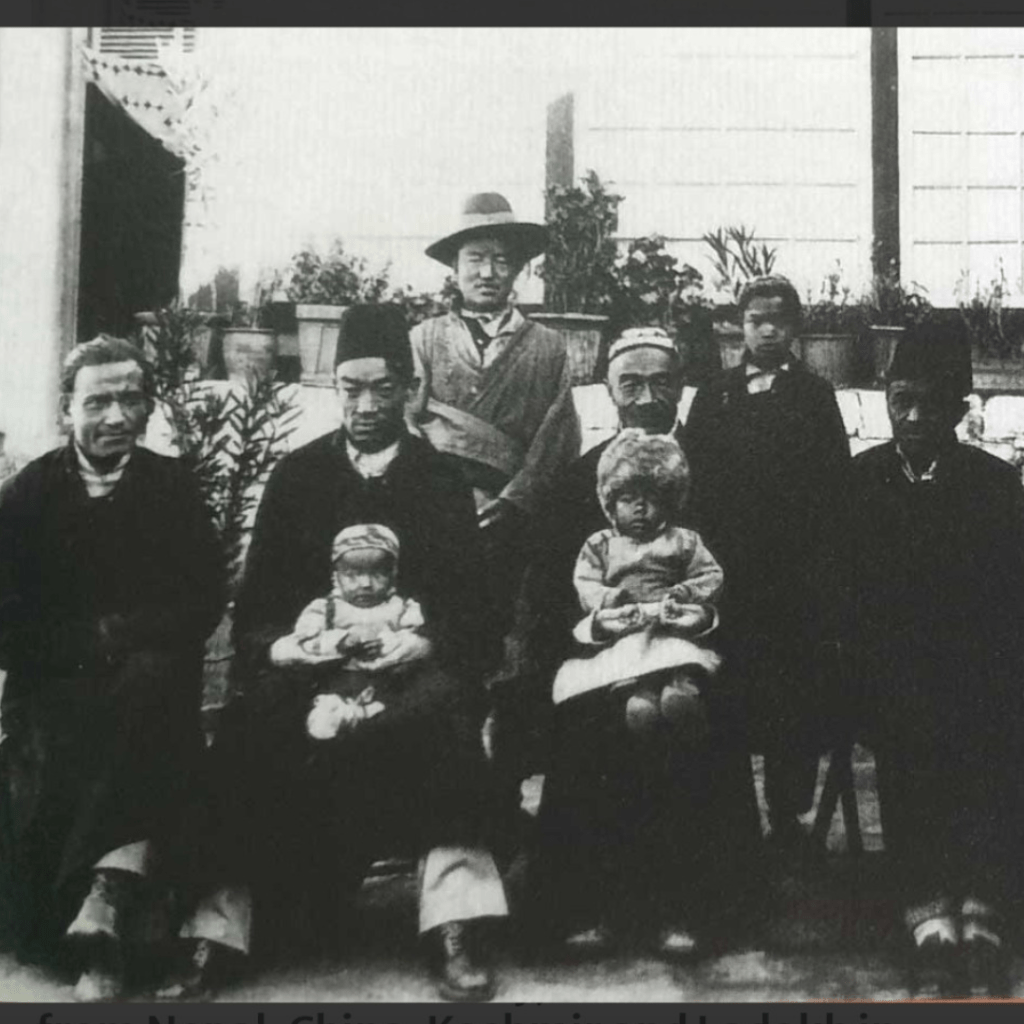
Tibetan Muslims were known as the Kache community in Tibet wherein Kache is a word derived from Kashmir. Kache community come from Kashmiri or Turkic descent through patrilineal lineage. They married Tibetan women when they settled in Tibet which later formed the genesis of intercultural religiosity of the Kache community. According to David Atwill, in the pre-twentieth century context of Tibet, Kache in Tibetan could simply refer to those who practiced Islam without a necessary ethnic affliliation.
Having had the good fortune to receive His Holiness The Dalai Lama’s teachings on ‘A Guide to the Bodhisattva’s Way of Life’ by Shantideva at Jiwestal (in Ladakh) amidst thousands of other devotees, I set out to read the book myself. I was stunned by the poetic beauty and simplicity of the teachings in the book by Shantideva.
One is not supposed to teach Dharma unless one has reached a certain level; so this article is in no way an instruction, but a mere layman’s appreciation of the book written by a great Buddhist master.
How is Zanskar seen from different perspectives- students who left their land for better education, families who migrated from Zanskar a long time ago, and a film that captures a remote Himalayan village?
—-Written by Sonam Chhomo Photographs sent by Anushka Kashyap Film pic taken from Lonely Planet
In the areas of Lahaul, Spiti and Ladakh, Tibet, Bhutan, Sikkim, and possibly Arunachal Pradesh, we have these traditional styled tables and mattresses in living rooms that are indigenously connected to our communities.
As a child, the question of gender inequality was quite foreign to me. Of course, I was aware of differences, but never of inequality per se.
-Rinchen Angmo
Image courtesy: watsupptoday.com
I grew up in spaces that were owned either by my maternal grandmother or by my mother. I guess this statement needs a bit of a context. In Ladakh, the system of marriage is very flexible in terms of which household the bride or the bridegroom goes to; meaning, either the bridegroom could go to the bride’s house(makpa) or vice versa(pagma). ‘Going to’ the other’s house also means assuming more responsibility over that household than your own. Both in my maternal grandmother’s and my mother’s case the bridegroom had come to their house; consequently, they received an equal share of family property. This is a common phenomenon in Ladakh and has been followed from time immemorial. In fact, even the daughters or sons who depart to another household after marriage attain a small share of family property. Hence, in Ladakh, the question of whether or not a woman can own property figures as a redundant one. Why does owning property become so important one may ask.. When one sees one’s mother or grandmother as a figure who owns property, manages it with finesse, and goes unquestioned by society, one also understands that those constructs of a-woman-can’t-handle-‘manly’-responsibilities, are after-all ‘man’-made fallacies.