Reflections on my recent visit to Harwan monastery, Srinagar

Written and photographed by Sonam Chhomo

An aerial view of the ruins at Harwan

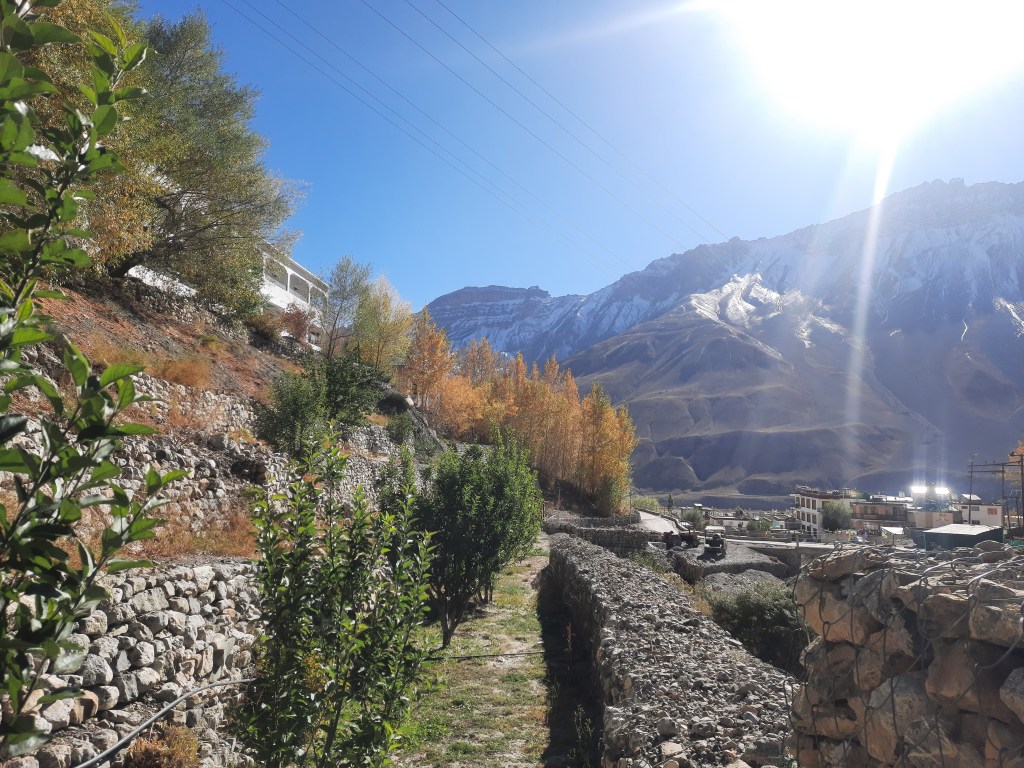
When I first reached Srinagar, I did not expect my relatives to suggest a visit to a monastery. Most historical narratives do not talk about Buddhist archaelogical sites in Kashmir. As part of the itinerary for the first day, we decided to see the Harwan garden and Harwan monastery. Harwan is a village near Srinagar, about 21 kms away from the city. Harwan garden is quite similar to other gardens, the dam stretching towards Dachigam. On our way back, we began our journey to the monastery.

The journey to the monastery was difficult to navigate; we had to keep an eye on a small green-colored signboard that indicated the direction to the monastery. We parked our vehicle inside a narrow pathway which led to residences and shops in the area. The monastery, as I came to know later, was up on a mountain hidden like a gem. What we saw was not just a monastery or the ruins of the monastery as I would later know but ruins of a chaitya, a structure that we deemed as a residence, and a stupa like structure. In order to reach the first part of the site i.e. the ruins of chaitya, residence, and stupa like structure, we had to climb some 200 steps/stairs. While climbing the stairs and then turning my back to look at the majestic mountains, we could clearly understand why the monks had chosen the place as their abode of living and enlightenment. We could hear the birds chirping, the wind gushing, and the chinar leaves holding their spirit still as the leaves rustled. What a perfect place to meditate! What an immense pleasure it was to revel in that silence!
Read more

Chil-shru: A story of five birds

Written by Nawang Chhoetso
A folktale from Spiti.

As I recall, it’s a story of five birds. But a friend of mine insisted that there were more than five birds, however even she wasn’t clear about the details. So this story will be about the tale of 5 birds.

Like all other folktales from Spiti, this too starts with the sentence ” yoyo metuk”- I don’t know what this means but every folktale starts with this sentence followed by “yul jaga chenmo na” -( in a big village). And then the story follows.

Read more

No Childik rang ache pula sum: A folktale from Spiti

Khara-thanga, Kaza(Spiti) .

Written by Nawang Chhoetso

“No Childik rang ache pula sum”-Brother Childik and his three sisters

It is probably my favourite tale, which was often narrated by my grandparents during my childhood before going to sleep.
It always starts with the sentence, “Ache pula sum la no chichik yotuk” i.e. three sisters had a younger brother named Childik.

Childik is a very unusual name as no one in our region has such a name. I am not sure if this name has any meaning. Maybe errors in oral traditions over several generations resulted in a name like Childik, or maybe it’s a word that we lost over the generations.
Although there is a word “Chikdil” in Bhoti language that means unity.

Read more

A Photo Essay of Spatial Weaves from Leh Market Area

Written and photographed by Rinchen Angmo

The pictures in this photo essay could possibly depict the myriad microcosms inhabited by different beings within the world of Leh Main Market area. Since I hadn’t taken these with the intention of later turning them into a photo essay, would it perhaps be okay to say that there is a somewhat natural element to the pictures’ composition? A somewhat natural element that wouldn’t have been captured if not for the mobility facilitated by new media.

   Two boys, one on roller skates and the other one with a skateboard .

Anyone who has been to Leh Main Market will know that the little kids who live in the area make the market their playground: playing football, cycling, skateboarding and roller skating. Skateboarding has really taken off in Leh. In a span of a few years, I have noticed an increasing number of skateboarders. This year, I also spotted many roller-skaters; could this be a convenient way to keep ice-skating skills intact? In Ladakh, during the winters, all water bodies get completely frozen: forming natural ice skating arenas. Hence, many take to the winter sport; however, since ice-skates are expensive, not many can afford the sport.

Read more

I, a mountain flaneur

A personal essay by Sonam C

On my way

There are times when I feel that I do not have a right to speak about my valley. After all, I have half a parentage from there. Since childhood, my sister and I have constantly juggled between identities that our multi-ethnic selves reflected in our facial features and body languages. If the places in which we lived commented on our not-so mainlandish features, our hometowns considered us the opposite. We looked quite different even from them. As the looks would always be an issue, I guess my family members tried looking at it from a different perspective. Instead of eyes, they would comment on how my hair resembled my aane’s. Instead of the tone of the skin, they would tell me that I behaved exactly like a Lahauli. Although I used to take these matters seriously, it’s only on reflection that I realize these were rueful complements to make me feel a part of the family, of the larger community.

Read more

A book review of ‘Tibetan Caravans’ by Abdul Wahid Radhu.

Written by Rinchen Angmo.

‘Tibetan Caravans’ is a book by Abdul Wahid Radhu le from Ladakh. Reading Wahid le’s book made me realize the importance of recording one’s life accounts for future generations. Since ‘History’ is often manipulated by various powers, individual stories become increasingly important. After all, it is through these individual stories that one gets a glimpse into a world that would otherwise have been forgotten, fabricated or made foreign.

Wahid le’s book assumes great significance in terms of documenting the waning days of trans-Himalayan trade as well as eye-witness accounts of the systemic attempt of the destruction of Tibetan culture and Tibetan Buddhism by the Communist Party of China in its early days of occupation. Moreover, it provides a glimpse of life in the trans-Himalayas before ‘modernization’ reached its doors.

Read more

Guru Rinpoche’s Lake.

-Written by Rinchen Angmo

It’s been more than a year. Last year around March, I made a pilgrimage to Tso Pema, tso meaning lake and pema meaning lotus; I will refer to the holy lake as Tso. Tso Pema is located in Rewalsar, Himachal Pradesh, India. For followers of Vajrayana Buddhism, Tso is a very holy site associated with Guru Rinpoche.

How do I describe the serenity of Tso? There is a sense of blessedness at Tso that escapes description. The jade green lake, the deep green trees and the pilgrims circumambulating around the holy lake, fill the air with a sense of serene jubilation.

Read more

Long live His Holiness the Dalai Lama.

written by Rinchen Angmo

It is very disturbing to witness how manipulative media houses and ignorant people have the audacity to try defame His Holiness the Dalia Lama who has dedicated every moment of his life for the well being of sentient beings. It is to challenge this audacity that I feel compelled to write this. For too long we have let hegemonic forces spew venom, it’s high time we put an end to contrived narratives that deliberately spread hate. 

Before I proceed I want to put forth some questions: Do you know what enlightenment means? Do you understand Buddhism? Do you understand the practices of Tibetan Buddhism? Do you understand what it means to perceive reality beyond duality? Do you understand what blessings mean? Do you understand the real meaning of compassion? Do you understand Tibetan culture? Do you understand that when one prostrates before statues it symbolizes the offering of body, speech and mind? Do understand the symbolic meaning of offering body, speech and mind? Do you understand the meaning of emptiness? Do you understand what it means to dedicate not just one, but several lifetimes for the well-being of other sentient beings?

Read more

New age Kinnauri weddings

-written by Karma Negi

Marriage is one of the most important institutions of any civilisation. It acts as the base of many societies. Various societies have their own rituals and customs for marriage.

And over time, the rituals and customs have evolved. In the old days, Kinnauri weddings used to happen for 4 days. But due to time constraints and other unknown reasons, marriages have now become just a 2 day event.

Read more

The disappearance of Buchen from Hangrang valley, upper Kinnaur

By Karma Negi

I still remember the times when the arrival of Buchen to our village was an annual event. Every year they would appear in the winter months, when all the villagers were done with their farm work and were about to go into resting mode, and then after days of performances, Buchen would disappear for the rest of the year. I remember the Buchen who would go to different villages one after another spreading religious knowledge in dramatic and witty ways.

Read more

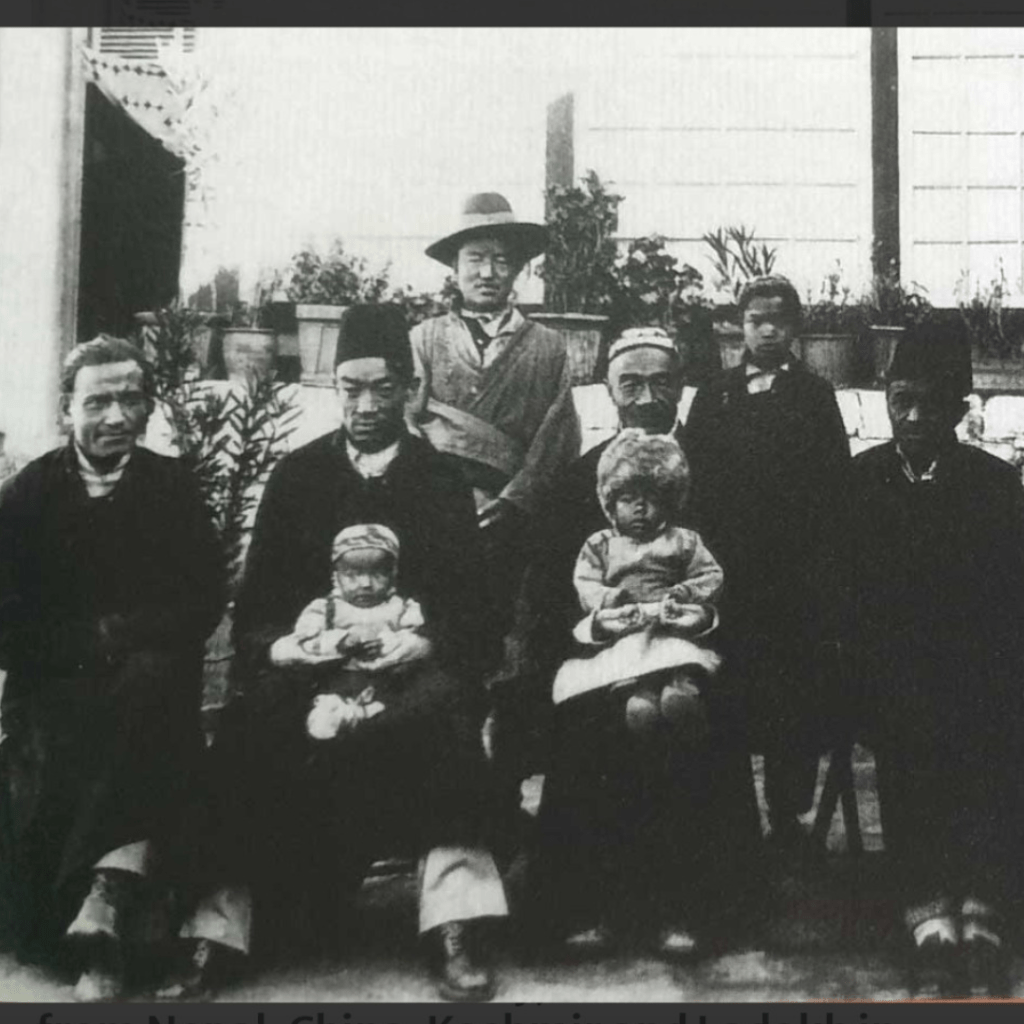
Kache community of Tibet

By Sonam Chhomo

Image source: Siddiq Wahid, Tibetan Muslims in Tibet, 2022, accessed via https://www.rfa.org/english/news/tibet/muslims-tradition-01142022181835.html

Tibetan Muslims were known as the Kache community in Tibet wherein Kache is a word derived from Kashmir. Kache community come from Kashmiri or Turkic descent through patrilineal lineage. They married Tibetan women when they settled in Tibet which later formed the genesis of intercultural religiosity of the Kache community. According to David Atwill, in the pre-twentieth century context of Tibet, Kache in Tibetan could simply refer to those who practiced Islam without a necessary ethnic affliliation.

Read more

The History of Bodyig (Tibetan script) and its current state in different regions.

Written by Rinchen Angmo.

The Bodyig script was created owing to the vision and foresight of one of the greatest Tibetan Kings, Chogyal Songsten Gampo, the 7th century ruler of Tibet. The King realized that the advancing kingdom of Tibet would soon require its own script. Chogyal Songsten Gampo sent his intelligent minister Thonmi Sambhota to India with fifteen other young Tibetans so that they could learn Indian languages whereby they could develop a script for Tibet. On Thonmi Sambhota’s return from India, the Tibetan script was finalized.

Bodyig also known in some regions as Bodhik or Bhoti, is the script that became indigenous to Tibet, Ladakh, Lahaul (sTod valley), Spiti, Bhutan (Dzongkha), Baltistan, Sikkim (for Bhutias) and other regions. However, the usage of the script is slowly waning in many regions.

Read more