No Childik rang ache pula sum: A folktale from Spiti

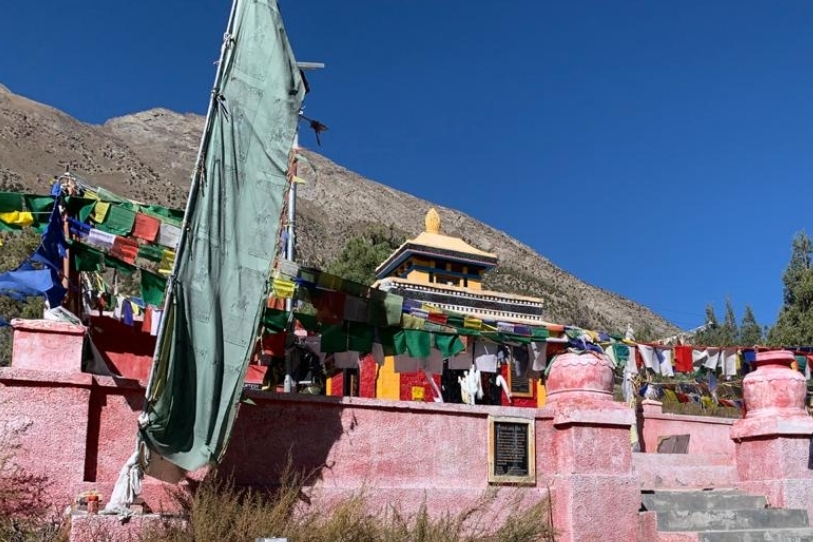
Khara-thanga, Kaza(Spiti) .

Written by Nawang Chhoetso

“No Childik rang ache pula sum”-Brother Childik and his three sisters

It is probably my favourite tale, which was often narrated by my grandparents during my childhood before going to sleep.
It always starts with the sentence, “Ache pula sum la no chichik yotuk” i.e. three sisters had a younger brother named Childik.

Childik is a very unusual name as no one in our region has such a name. I am not sure if this name has any meaning. Maybe errors in oral traditions over several generations resulted in a name like Childik, or maybe it’s a word that we lost over the generations.
Although there is a word “Chikdil” in Bhoti language that means unity.

Read more

A Photo Essay of Spatial Weaves from Leh Market Area

Written and photographed by Rinchen Angmo

The pictures in this photo essay could possibly depict the myriad microcosms inhabited by different beings within the world of Leh Main Market area. Since I hadn’t taken these with the intention of later turning them into a photo essay, would it perhaps be okay to say that there is a somewhat natural element to the pictures’ composition? A somewhat natural element that wouldn’t have been captured if not for the mobility facilitated by new media.

   Two boys, one on roller skates and the other one with a skateboard .

Anyone who has been to Leh Main Market will know that the little kids who live in the area make the market their playground: playing football, cycling, skateboarding and roller skating. Skateboarding has really taken off in Leh. In a span of a few years, I have noticed an increasing number of skateboarders. This year, I also spotted many roller-skaters; could this be a convenient way to keep ice-skating skills intact? In Ladakh, during the winters, all water bodies get completely frozen: forming natural ice skating arenas. Hence, many take to the winter sport; however, since ice-skates are expensive, not many can afford the sport.

Read more

I, a mountain flaneur

A personal essay by Sonam C

On my way

There are times when I feel that I do not have a right to speak about my valley. After all, I have half a parentage from there. Since childhood, my sister and I have constantly juggled between identities that our multi-ethnic selves reflected in our facial features and body languages. If the places in which we lived commented on our not-so mainlandish features, our hometowns considered us the opposite. We looked quite different even from them. As the looks would always be an issue, I guess my family members tried looking at it from a different perspective. Instead of eyes, they would comment on how my hair resembled my aane’s. Instead of the tone of the skin, they would tell me that I behaved exactly like a Lahauli. Although I used to take these matters seriously, it’s only on reflection that I realize these were rueful complements to make me feel a part of the family, of the larger community.

Read more

New age Kinnauri weddings

-written by Karma Negi

Marriage is one of the most important institutions of any civilisation. It acts as the base of many societies. Various societies have their own rituals and customs for marriage.

And over time, the rituals and customs have evolved. In the old days, Kinnauri weddings used to happen for 4 days. But due to time constraints and other unknown reasons, marriages have now become just a 2 day event.

Read more

The disappearance of Buchen from Hangrang valley, upper Kinnaur

By Karma Negi

I still remember the times when the arrival of Buchen to our village was an annual event. Every year they would appear in the winter months, when all the villagers were done with their farm work and were about to go into resting mode, and then after days of performances, Buchen would disappear for the rest of the year. I remember the Buchen who would go to different villages one after another spreading religious knowledge in dramatic and witty ways.

Read more

Tales of Zanskar

How is Zanskar seen from different perspectives- students who left their land for better education, families who migrated from Zanskar a long time ago, and a film that captures a remote Himalayan village?

—-Written by Sonam Chhomo Photographs sent by Anushka Kashyap Film pic taken from Lonely Planet

Read more

Shungma

By Sonam Chhomo

Shungma, Jispa, Lahaul valley

The experience of visiting places you always wanted to see for yourself is ethereal. The journey to this shungma felt almost as if I had been divinely allowed to enter its doorstep after many years of waiting for the perfect opportunity to unfold. As a child, I resisted visiting places at high altitudes because Lahaul was/is not a weather friendly place especially during the winter months. Even this time (it happened after a day), my ears remained blocked and my body felt uncomfortable for about two days.

But this year I felt as if I accomplished something.

Read more

Chodpa Festival, Khangzar

By Sonam Chhomo

Khangzar Khar, Lahaul valley, Picture credits: unknown person from Lahaul. 

Khangzar palace or locally known as the Khangzar Khar is the only palace which exists in the sTod valley (the upper valley of Lahaul valley). It was the home of the Jo/Thakurs/Wazir of Khangzar and the birthplace of Queen mother of Ladakh, Rani Parvati Devi Deskit Wangmo.

Yesterday the villagers of sTod valley (the upper valley of Lahaul valley) celebrated the Chodpa festival at the Khar where the villagers gathered and paid respect to the local Gods. 

Read more

A reflection of the reflections about the Chhorten at Leh Palace

-Rinchen Angmo

Chhorten at Leh Palace


There’s something very interesting about the Chhorten wing (side) of the Leh Palace. The balcony which provides a path for skora (cicumambulation) around the chhorten presents a world in itself. On one side stands the majestic Leh Palace, golden in the light of the setting sun. While Old Leh Town tumbles beneath in all its crooked beauty. And beyond that lies Leh city, an urban landscape. We often venture to remote parts of Ladakh to find beauty, but in our very own Leh are remnants untouched by urbanity. 

Read more

Women of Spiti

One thing that I find common in the women of my region Spiti, is that they have a choice and say in all aspects of life.

-Nawang Chhoetso

Spiti women

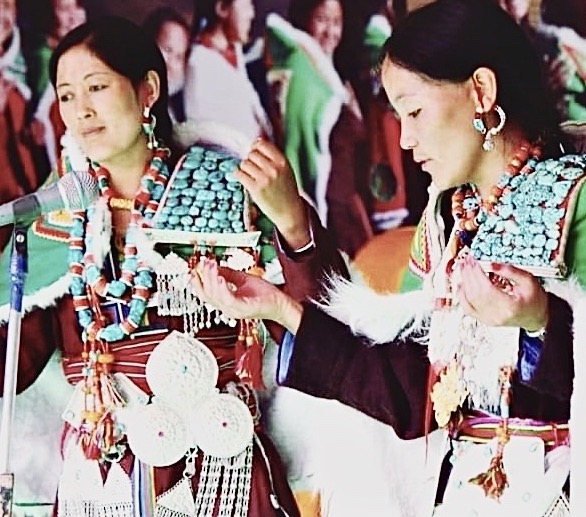
The older generation of women -from my grandmother’s age group- are primarily housewives. Their succeeding generation went on to expand their horizons by exploring various career opportunities. Hence, women of my mother’s age group engage in a diverse range of jobs and activities, as teachers, nurses and various other occupations. My generation has ahead us of us a greater number of options. But, what has remained constant for women from all three generations has been the right to make our own decisions. 

Read more