By Rinchen Angmo
Someday we’ll stand in front of Singey Khababs (River Indus),
It’ll be a witness to us,
To our hopes and dreams,
To our tears and screams,
By Rinchen Angmo
Someday we’ll stand in front of Singey Khababs (River Indus),
It’ll be a witness to us,
To our hopes and dreams,
To our tears and screams,
By Lungmying Lepcha
“Put yourself behind my eyes and see me as I see myself, for I have chosen to dwell in a place you cannot see “ -Rumi
I used to think that aamik (translated as eyes in Lepcha) is the only way one can perceive life. Aamik in Lepcha means eyes. It is an impactful word among my family members who mostly wear glasses for better vision. I believe it is with the aamik that we are able to peer at the world.
Read moreBy Manya Ohri
Read moreWritten by Lungmying Lepcha
the cold
crisp
winds
from the breath of the mountain
knocks through my table and to my ear
to wake me up
from the still sleep I occupy
in the afternoon sun ,
By Lhundup Gyalpo
Picture this: An alpine desert forest is yet to receive its share of rain. For now, all it boasts of is an overgrowth of shrubs and thorns; dull, prickly, and urgently jostling for every nook of the forest. In a busy yet insipid corner of the parched forest, a yellow dandelion blooms silently, perky yet serene, pleasing to watch, and assuredly present.
Read moreBy Lhundup Gyalpo
A bunch of yellow and listless leaves rustled in a small eddy by the closed door. The wind blew in a melancholic whirl, whistling in a doleful hum. Nine thirty-two in the morning, the house was still dimly lit, bereft of light; a thick overcast kept the sun away in its sombre folds.
Read moreBy Priya Srivastava
Read moreWritten by Divya Sharma
Read moreBy Shreyansh Pradhan

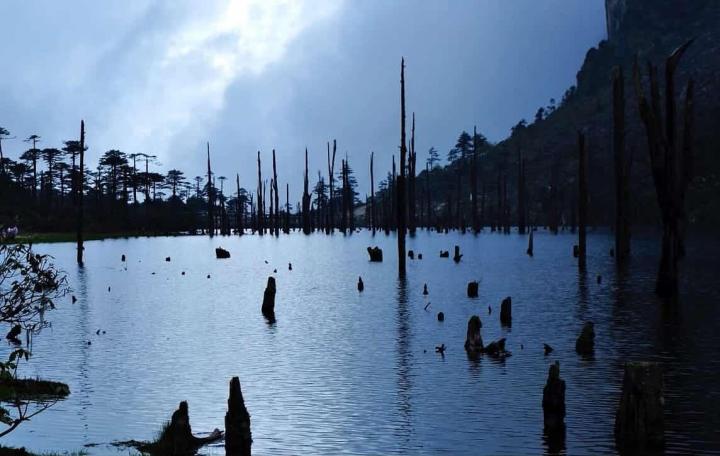
A poem written by Lungmying Lepcha
I am because
we are
(A quote inspired by Cholhamu Lepcha )
It’s within me “deep inside “
We are not known by our surname
but by our anum Chu (mountains) ,
anom and anum
Aungkyongsong (rivers)
our mother Rungyu and father Rungeet
our eldest brother Anum Kongchen (Mt Kanchenjunga) and
to all the clans connected
within us .
By Sonam Chhomo
My family friends came to meet us a day after the beginning of the Tibetan New Year and Fagli, the new year celebrated by the people of the Pattan Valley in Lahaul. They were cheery and happy like always. They told me how they used to spend their winter days in Lahaul as children. It started from their school days and ended up discussing the pack of young boys who used to take notice of the shepherds from Zanskar and use their donkeys to ride in the fields. From picking apples from a neighbor’s farm to playing with a bow and arrow in the field, they concluded: “You have never experienced this joy in the cities.” I agreed with her since our city life was almost devoid of the community and nature that Lahual offered. In the next few silent minutes, my aunt finally asked me about my meeting with Jetsunma. She later revealed how she met Jetsunma Palmo. Her first meeting was surprisingly in that same cave that Jetsunma had resided in. She had gone on one of her expeditions with her father to the jungle. One day, as she was the youngest in that expedition, she was sent to her to ask for some salt. The first meeting was the simple act of getting salt from Jetsunma. The second time she met her was at a function organized by some monks from Kinnaur. At a random book collection for her daughter at Capital Book Depot in Chandigarh, she came across a book with a cover image of someone she knew. On further notice, she recognized Jetsunma Tenzin Palmo in her first book. Her meetings with her happened by chance as if fate was just unveiling itself as she opened one door to another.
Read moreWritten and photographed by Karma Negi.
Losar is the new year celebration in most parts of Kinnaur and Himalayan regions where there is an influence of Himalayan Buddhism. Losar breaks up into two words ‘Lo’ (Year) and ‘Sar’ (New). Every year it is celebrated according to the Tibetan calendar so it doesn’t fall on the 1st of January. The dates vary even amongst the regions that celebrate Losar.
In Kinnaur region, the Losar of Lippa is the most famous one; this year their losar was celebrated from 24th to 26th December. People from nearby places come to enjoy the three-day grand celebrations. Lippa is one of the biggest villages of Kinnaur. While travelling, we have to take a diversion from Akpa or Kiran Nallah on the National Highway 505. The village is a bit remote and reaching there is a task. The whole village is situated on a steep mountain, with a river flowing right below the village.

Written and photographed by Sonam Chhomo

When I first reached Srinagar, I did not expect my relatives to suggest a visit to a monastery. Most historical narratives do not talk about Buddhist archaelogical sites in Kashmir. As part of the itinerary for the first day, we decided to see the Harwan garden and Harwan monastery. Harwan is a village near Srinagar, about 21 kms away from the city. Harwan garden is quite similar to other gardens, the dam stretching towards Dachigam. On our way back, we began our journey to the monastery.
The journey to the monastery was difficult to navigate; we had to keep an eye on a small green-colored signboard that indicated the direction to the monastery. We parked our vehicle inside a narrow pathway which led to residences and shops in the area. The monastery, as I came to know later, was up on a mountain hidden like a gem. What we saw was not just a monastery or the ruins of the monastery as I would later know but ruins of a chaitya, a structure that we deemed as a residence, and a stupa like structure. In order to reach the first part of the site i.e. the ruins of chaitya, residence, and stupa like structure, we had to climb some 200 steps/stairs. While climbing the stairs and then turning my back to look at the majestic mountains, we could clearly understand why the monks had chosen the place as their abode of living and enlightenment. We could hear the birds chirping, the wind gushing, and the chinar leaves holding their spirit still as the leaves rustled. What a perfect place to meditate! What an immense pleasure it was to revel in that silence!
Written by Nawang Chhoetso
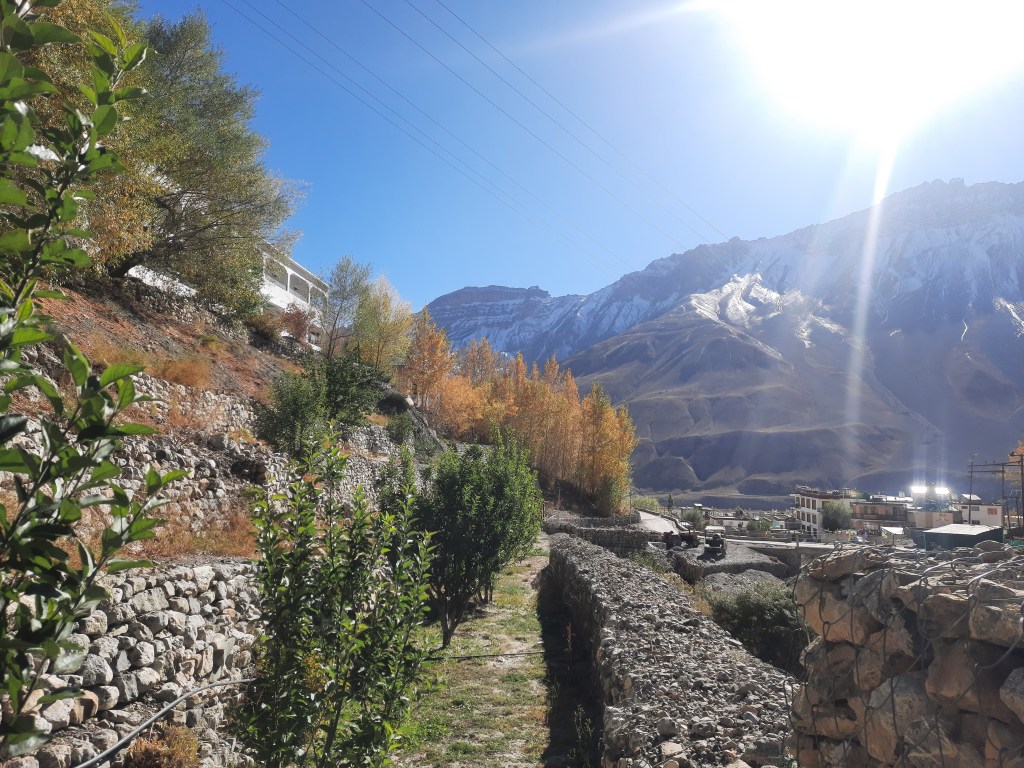
A folktale from Spiti.
As I recall, it’s a story of five birds. But a friend of mine insisted that there were more than five birds, however even she wasn’t clear about the details. So this story will be about the tale of 5 birds.
Like all other folktales from Spiti, this too starts with the sentence ” yoyo metuk”- I don’t know what this means but every folktale starts with this sentence followed by “yul jaga chenmo na” -( in a big village). And then the story follows.
Read more