The frozen mirror

By Lhundup Gyalpo

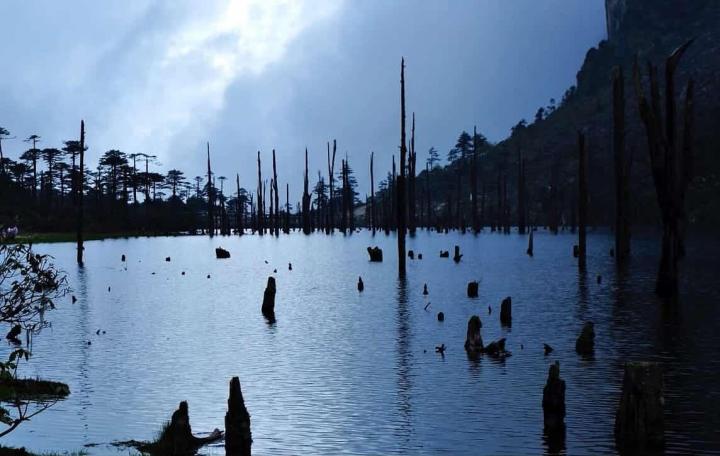
A bunch of yellow and listless leaves rustled in a small eddy by the closed door. The wind blew in a melancholic whirl, whistling in a doleful hum. Nine thirty-two in the morning, the house was still dimly lit, bereft of light; a thick overcast kept the sun away in its sombre folds.

Read more

Destined encounters with Jetsunma Tenzin Palmo

By Sonam Chhomo

My family friends came to meet us a day after the beginning of the Tibetan New Year and Fagli, the new year celebrated by the people of the Pattan Valley in Lahaul. They were cheery and happy like always. They told me how they used to spend their winter days in Lahaul as children. It started from their school days and ended up discussing the pack of young boys who used to take notice of the shepherds from Zanskar and use their donkeys to ride in the fields. From picking apples from a neighbor’s farm to playing with a bow and arrow in the field, they concluded: “You have never experienced this joy in the cities.” I agreed with her since our city life was almost devoid of the community and nature that Lahual offered. In the next few silent minutes, my aunt finally asked me about my meeting with Jetsunma. She later revealed how she met Jetsunma Palmo. Her first meeting was surprisingly in that same cave that Jetsunma had resided in. She had gone on one of her expeditions with her father to the jungle. One day, as she was the youngest in that expedition, she was sent to her to ask for some salt. The first meeting was the simple act of getting salt from Jetsunma. The second time she met her was at a function organized by some monks from Kinnaur. At a random book collection for her daughter at Capital Book Depot in Chandigarh, she came across a book with a cover image of someone she knew. On further notice, she recognized Jetsunma Tenzin Palmo in her first book. Her meetings with her happened by chance as if fate was just unveiling itself as she opened one door to another.

Read more

New age Kinnauri weddings

-written by Karma Negi

Marriage is one of the most important institutions of any civilisation. It acts as the base of many societies. Various societies have their own rituals and customs for marriage.

And over time, the rituals and customs have evolved. In the old days, Kinnauri weddings used to happen for 4 days. But due to time constraints and other unknown reasons, marriages have now become just a 2 day event.

Read more

The History of Bodyig (Tibetan script) and its current state in different regions.

Written by Rinchen Angmo.

The Bodyig script was created owing to the vision and foresight of one of the greatest Tibetan Kings, Chogyal Songsten Gampo, the 7th century ruler of Tibet. The King realized that the advancing kingdom of Tibet would soon require its own script. Chogyal Songsten Gampo sent his intelligent minister Thonmi Sambhota to India with fifteen other young Tibetans so that they could learn Indian languages whereby they could develop a script for Tibet. On Thonmi Sambhota’s return from India, the Tibetan script was finalized.

Bodyig also known in some regions as Bodhik or Bhoti, is the script that became indigenous to Tibet, Ladakh, Lahaul (sTod valley), Spiti, Bhutan (Dzongkha), Baltistan, Sikkim (for Bhutias) and other regions. However, the usage of the script is slowly waning in many regions.

Read more

Wandering Watze.

A red fox on a full moon’s night.

Written by Rinchen.

My dog’s more aggressive-than-usual- bark got me to peek out of the window. A pointed snout, bushy tail and thin body.. behold the Himalayan Red Fox (known as watze in Ladakh) glimmering under the full moon’s radiance. From its body language, I inferred that it was a frequent visitor. As at any other occasion, I wondered what it meant..symbolically that is.

Read more

Shungma

By Sonam Chhomo

Shungma, Jispa, Lahaul valley

The experience of visiting places you always wanted to see for yourself is ethereal. The journey to this shungma felt almost as if I had been divinely allowed to enter its doorstep after many years of waiting for the perfect opportunity to unfold. As a child, I resisted visiting places at high altitudes because Lahaul was/is not a weather friendly place especially during the winter months. Even this time (it happened after a day), my ears remained blocked and my body felt uncomfortable for about two days.

But this year I felt as if I accomplished something.

Read more

Stories and whatnot tales from the Himalayas: the tradition of Teer-Kaman

There are stories which we choose to share and stories which irrevocably fade away with time. 

— Sonam Chhomo and Nawang Chhoetso

.

When we ask them about their stories, you would notice a sense of hesitation in the beginning, but internally we all know that they are too eager to feel the same emotions again as they traverse through memory lane. And when they speak, you’ll notice that it becomes hard to stop them, you fear interrupting them lest they change their mind and become silent after a pause. You don’t want that to happen, do you? You too want to understand them and wish to find yourself a place in their memory so that you witness them first hand, look at their obscurities and in a childish spree compare yourself to them. Of course our imagination too helps us to walk this same path as they start travelling back to these days in the hope of reliving their most loved memories.

.

Perhaps listening to their stories may retain the authenticity of these experiences which no travel book may hold, perhaps their stories will be the last reminiscent of their generation’s experiences and it is only fair as this becomes our duty to document these as part of history, our history. .

Read more