Written by Divya Sharma
Read morePangong Tso, a living remnant of natural history.
-Written and photographed by Rinchen Angmo
Pangong Tso is so much more than a water body, it is a living remnant of natural history.
Anyone who’s been to Pangong Tso will testify to it’s limitless beauty. Glittering amidst snow capped mountains, the water body is one of its kinds. Different hues of blue adorn it’s large expanse.
Pangong Tso is not only a beautiful water body but also a living remnant of natural history. According to geography, the Tethys sea was an ancient water body that existed in this part of the world. As the two continents collided to give rise to the Himalayas, the sea was subsumed, except some bits of it which remained as lakes. Other theories trace the origin of high altitude lakes to later tectonic activities. Either way, lakes like Pangong Tso in the Trans-Himalayas are living remnants of natural history.

apricot blossoms, a note.
-Written by Rinchen Angmo
Spid is the closest possible translation of spring in Ladakhi, yet the aura that the word carries is markedly different. The word spring has this feeling of freshness. Yet when I think of the word for spring in Ladakhi, that is spid, it reminds me of the windy days in April and of course apricot blossoms. According to my Abile (granny) spid aligns with the first three months of our traditional calendar. Typically, spid is characterised by strong winds known as spid lungs or spring winds. Hence, the Ladakhi image of spring is quite different from the one that is conjured by the English word.
Read moreNas, the root of my food associated existence.
Written by Rinchen Angmo
Nas, the food associated root of my existence. The Ladakhi word for barley is nas. For centuries, the people of Ladakh, Tibet, Spiti, Lahaul and various places across the Trans-Himalayas have cultivated barley. In most parts of the aforementioned places, a barley based dish called kholak/tsampa has from time immemorial been a staple diet.
Though I don’t eat kholak as often as I would like to, the dish inevitably becomes a symbol of the root of my food associated existence. I say food associated specifically, because there are various other ways of quantifying roots of existence in different tangible and philosophical spheres.

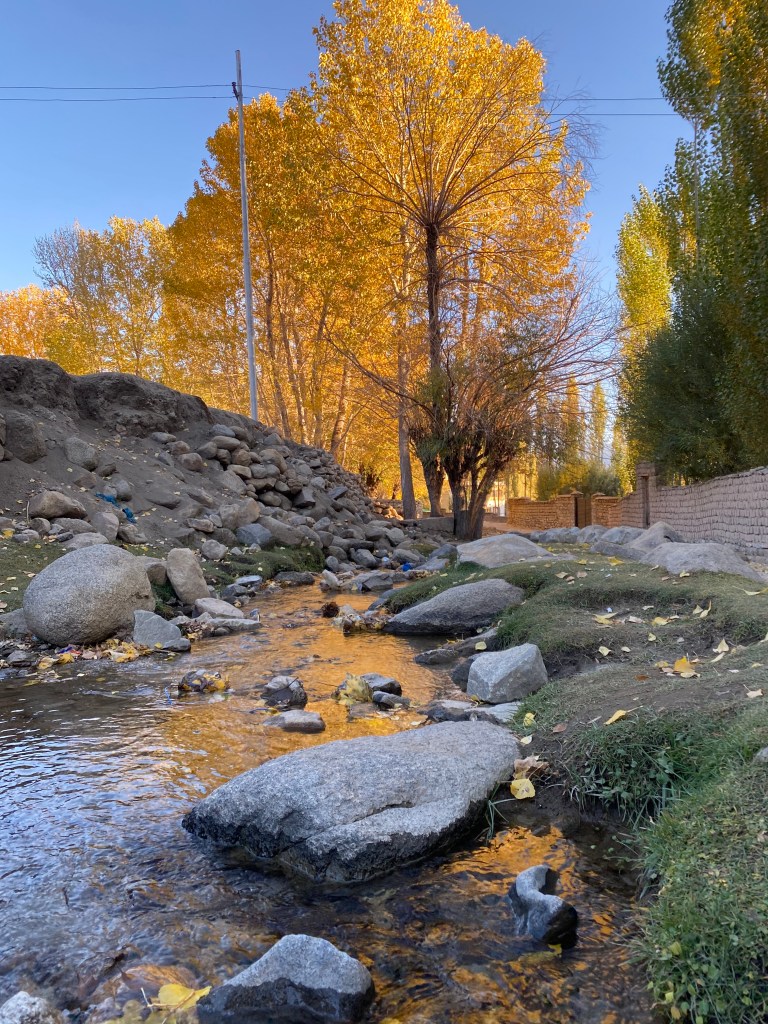
Ought to know something about autumn, ya?
-Written and photographed by Rinchen Angmo
Seasons, they come and go, just like the thoughts in my mind. Even feelings come and go, but they stay a while longer than thoughts do. Yellow leaves, do they make me think of different songs?
Somehow even when I’m not in my homeland, my mind invariably registers different months vis-à-vis the seasons of my homeland. May, there will be apricot blossoms in Ladakh; June, the weather in Ladakh will be pleasant; October, the leaves will turn yellow; December, it will be very cold in Ladakh. That’s why no matter where I am, my mind always understands different months through the lens of the different seasons of Ladakh.
A Photo Essay of Spatial Weaves from Leh Market Area
Written and photographed by Rinchen Angmo
The pictures in this photo essay could possibly depict the myriad microcosms inhabited by different beings within the world of Leh Main Market area. Since I hadn’t taken these with the intention of later turning them into a photo essay, would it perhaps be okay to say that there is a somewhat natural element to the pictures’ composition? A somewhat natural element that wouldn’t have been captured if not for the mobility facilitated by new media.

Anyone who has been to Leh Main Market will know that the little kids who live in the area make the market their playground: playing football, cycling, skateboarding and roller skating. Skateboarding has really taken off in Leh. In a span of a few years, I have noticed an increasing number of skateboarders. This year, I also spotted many roller-skaters; could this be a convenient way to keep ice-skating skills intact? In Ladakh, during the winters, all water bodies get completely frozen: forming natural ice skating arenas. Hence, many take to the winter sport; however, since ice-skates are expensive, not many can afford the sport.
Read moreA book review of ‘Tibetan Caravans’ by Abdul Wahid Radhu.
Written by Rinchen Angmo.
‘Tibetan Caravans’ is a book by Abdul Wahid Radhu le from Ladakh. Reading Wahid le’s book made me realize the importance of recording one’s life accounts for future generations. Since ‘History’ is often manipulated by various powers, individual stories become increasingly important. After all, it is through these individual stories that one gets a glimpse into a world that would otherwise have been forgotten, fabricated or made foreign.
Wahid le’s book assumes great significance in terms of documenting the waning days of trans-Himalayan trade as well as eye-witness accounts of the systemic attempt of the destruction of Tibetan culture and Tibetan Buddhism by the Communist Party of China in its early days of occupation. Moreover, it provides a glimpse of life in the trans-Himalayas before ‘modernization’ reached its doors.
Read moreGuru Rinpoche’s Lake.
-Written by Rinchen Angmo
It’s been more than a year. Last year around March, I made a pilgrimage to Tso Pema, tso meaning lake and pema meaning lotus; I will refer to the holy lake as Tso. Tso Pema is located in Rewalsar, Himachal Pradesh, India. For followers of Vajrayana Buddhism, Tso is a very holy site associated with Guru Rinpoche.
How do I describe the serenity of Tso? There is a sense of blessedness at Tso that escapes description. The jade green lake, the deep green trees and the pilgrims circumambulating around the holy lake, fill the air with a sense of serene jubilation.
Read moreLong live His Holiness the Dalai Lama.
written by Rinchen Angmo
It is very disturbing to witness how manipulative media houses and ignorant people have the audacity to try defame His Holiness the Dalia Lama who has dedicated every moment of his life for the well being of sentient beings. It is to challenge this audacity that I feel compelled to write this. For too long we have let hegemonic forces spew venom, it’s high time we put an end to contrived narratives that deliberately spread hate.
Before I proceed I want to put forth some questions: Do you know what enlightenment means? Do you understand Buddhism? Do you understand the practices of Tibetan Buddhism? Do you understand what it means to perceive reality beyond duality? Do you understand what blessings mean? Do you understand the real meaning of compassion? Do you understand Tibetan culture? Do you understand that when one prostrates before statues it symbolizes the offering of body, speech and mind? Do understand the symbolic meaning of offering body, speech and mind? Do you understand the meaning of emptiness? Do you understand what it means to dedicate not just one, but several lifetimes for the well-being of other sentient beings?
Read moreLadakh, 6th Schedule and The Third Pole: What happens when glaciers melt away?
Written by Rinchen Angmo
The third pole derives its name from the fact that it contains the largest reserve of freshwater after the North and South Pole. The glaciers of the third pole feed some of the major rivers of Asia including Indus, Ganga, Brahmaputra, Mekong, Yangtze and the Yellow Rivers (Banskota 64). Can we really not talk about the fate of regions that form the third pole when it is the source of the ‘10 major river systems that provide irrigation, power and drinking water to over 1.9 billion people in Asia – over 24 % of the world’s population’? (thetthirdpole.net). When we see these figures, we must bear in mind that behind each number is an individual life, be it of a human or an animal. The magnitude of suffering that the imminent climate crisis can cause is beyond our imagination.
Read moreA layman’s reflections on ‘A Guide to the Bodhisattva’s Way of Life’ by Shantideva.
by Rinchen Angmo
Having had the good fortune to receive His Holiness The Dalai Lama’s teachings on ‘A Guide to the Bodhisattva’s Way of Life’ by Shantideva at Jiwestal (in Ladakh) amidst thousands of other devotees, I set out to read the book myself. I was stunned by the poetic beauty and simplicity of the teachings in the book by Shantideva.
One is not supposed to teach Dharma unless one has reached a certain level; so this article is in no way an instruction, but a mere layman’s appreciation of the book written by a great Buddhist master.
Read moreThe History of Bodyig (Tibetan script) and its current state in different regions.
Written by Rinchen Angmo.
The Bodyig script was created owing to the vision and foresight of one of the greatest Tibetan Kings, Chogyal Songsten Gampo, the 7th century ruler of Tibet. The King realized that the advancing kingdom of Tibet would soon require its own script. Chogyal Songsten Gampo sent his intelligent minister Thonmi Sambhota to India with fifteen other young Tibetans so that they could learn Indian languages whereby they could develop a script for Tibet. On Thonmi Sambhota’s return from India, the Tibetan script was finalized.
Bodyig also known in some regions as Bodhik or Bhoti, is the script that became indigenous to Tibet, Ladakh, Lahaul (sTod valley), Spiti, Bhutan (Dzongkha), Baltistan, Sikkim (for Bhutias) and other regions. However, the usage of the script is slowly waning in many regions.
Read moreShey Shrubh Lha.
-Written by Rinchen.
My Abile(granny) said that today is Shey Shrubhlha: the day on which Shey’s protector deity Dorje Chenmo enters a human being in order to give advice to the village of Shey. The day of Shrubh lha also marks the beginning of harvest. I’m not exactly sure how this spans out these days and all that I know about how it spanned out back in my granny’s youth is stemming from bits of memories that my granny still holds. For those who don’t know, Shey, now a village, was once the summer capital of the Kingdom of Ladakh.
My granny said two of the things she remembers from this occasion is that on this day Dorje Chenmo using a human being as a medium visits the Shey Lonpo House ( one of the foremost erstwhile ministerial families in Ladakh during the King’s reign) and a traditional dance is held on the lawn before the Lha-khang (abode of the lha (deity), in this case Dorje Chenmo). Ofcourse, other important events also take place on this occasion, but these are the two which my grandmother recalls from personal experience.
A beautifully surreal month.
Written by Rinchen.
I would like to begin by thanking His Holiness The Dalai Lama for blessing and bringing so much joy to all the people of Ladakh. Chhaksal.
Each day of His Holiness’s presence in Ladakh has been filled with beauty and wonder for each and every Ladakhi in so many different ways. His Holiness’s interfaith visits, secular teachings, religious teachings, visits to Zanskar and Lingshed, and the various functions that were hosted in his honour, brought blessings upon and joy to a countless number of beings who had the sode and sonam (luck and merit) to be in His Holiness’s presence. We Ladakhis are truly honoured to have had His Holiness visit Ladakh as his first destination since the pandemic broke out.
We will miss all the beautiful moments that His Holiness’s visit brought and now look forward to His Holiness’s visit next year.
Read more