Stories and whatnot tales from the Himalayas: the tradition of Teer-Kaman

There are stories which we choose to share and stories which irrevocably fade away with time. 

— Sonam Chhomo and Nawang Chhoetso

.

When we ask them about their stories, you would notice a sense of hesitation in the beginning, but internally we all know that they are too eager to feel the same emotions again as they traverse through memory lane. And when they speak, you’ll notice that it becomes hard to stop them, you fear interrupting them lest they change their mind and become silent after a pause. You don’t want that to happen, do you? You too want to understand them and wish to find yourself a place in their memory so that you witness them first hand, look at their obscurities and in a childish spree compare yourself to them. Of course our imagination too helps us to walk this same path as they start travelling back to these days in the hope of reliving their most loved memories.

.

Perhaps listening to their stories may retain the authenticity of these experiences which no travel book may hold, perhaps their stories will be the last reminiscent of their generation’s experiences and it is only fair as this becomes our duty to document these as part of history, our history. .

Read more

Women in Ladakh

As a child, the question of gender inequality was quite foreign to me. Of course, I was aware of differences, but never of inequality per se.

-Rinchen Angmo

Image courtesy: watsupptoday.com

I grew up in spaces that were owned either by my maternal grandmother or by my mother. I guess this statement needs a bit of a context. In Ladakh, the system of marriage is very flexible in terms of which household the bride or the bridegroom goes to; meaning, either the bridegroom could go to the bride’s house(makpa) or vice versa(pagma). ‘Going to’ the other’s house also means assuming more responsibility over that household than your own. Both in my maternal grandmother’s and my mother’s case the bridegroom had come to their house; consequently, they received an equal share of family property. This is a common phenomenon in Ladakh and has been followed from time immemorial. In fact, even the daughters or sons who depart to another household after marriage attain a small share of family property. Hence, in Ladakh, the question of whether or not a woman can own property figures as a redundant one. Why does owning property become so important one may ask.. When one sees one’s mother or grandmother as a figure who owns property, manages it with finesse, and goes unquestioned by society, one also understands that those constructs of a-woman-can’t-handle-‘manly’-responsibilities, are after-all ‘man’-made fallacies. 

Read more

Women of Spiti

One thing that I find common in the women of my region Spiti, is that they have a choice and say in all aspects of life.

-Nawang Chhoetso
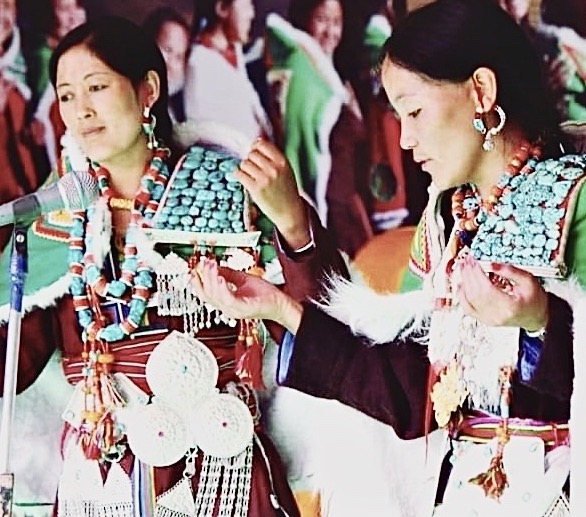
Spiti women

The older generation of women -from my grandmother’s age group- are primarily housewives. Their succeeding generation went on to expand their horizons by exploring various career opportunities. Hence, women of my mother’s age group engage in a diverse range of jobs and activities, as teachers, nurses and various other occupations. My generation has ahead us of us a greater number of options. But, what has remained constant for women from all three generations has been the right to make our own decisions. 

Read more