The History of Bodyig (Tibetan script) and its current state in different regions.

Written by Rinchen Angmo.

The Bodyig script was created owing to the vision and foresight of one of the greatest Tibetan Kings, Chogyal Songsten Gampo, the 7th century ruler of Tibet. The King realized that the advancing kingdom of Tibet would soon require its own script. Chogyal Songsten Gampo sent his intelligent minister Thonmi Sambhota to India with fifteen other young Tibetans so that they could learn Indian languages whereby they could develop a script for Tibet. On Thonmi Sambhota’s return from India, the Tibetan script was finalized.

Bodyig also known in some regions as Bodhik or Bhoti, is the script that became indigenous to Tibet, Ladakh, Lahaul (sTod valley), Spiti, Bhutan (Dzongkha), Baltistan, Sikkim (for Bhutias) and other regions. However, the usage of the script is slowly waning in many regions.

Read more
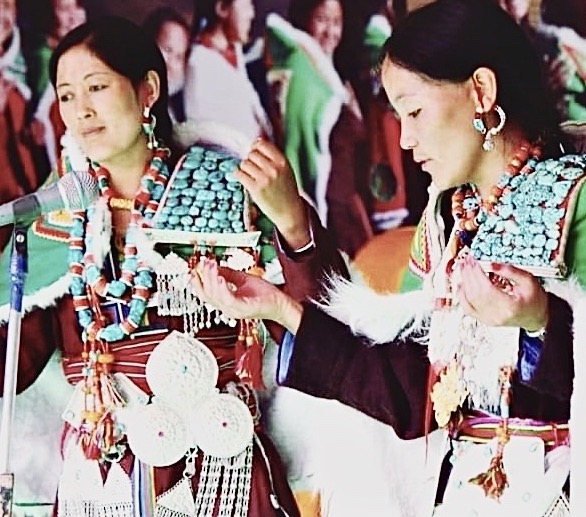
Shey Shrubh Lha.

-Written by Rinchen.

My Abile(granny) said that today is Shey Shrubhlha: the day on which Shey’s protector deity Dorje Chenmo enters a human being in order to give advice to the village of Shey. The day of Shrubh lha also marks the beginning of harvest.  I’m not exactly sure how this spans out these days and all that I know about how it spanned out back in my granny’s youth is stemming from bits of memories that my granny still holds. For those who don’t know, Shey, now a village, was once the summer capital of the Kingdom of Ladakh.

My granny said two of the things she remembers from this occasion is that on this day Dorje Chenmo using a human being as a medium visits the Shey Lonpo House ( one of the foremost erstwhile ministerial families in Ladakh during the King’s reign) and a traditional dance is held on the lawn before the Lha-khang (abode of the lha (deity), in this case Dorje Chenmo). Ofcourse, other important events also take place on this occasion, but these are the two which my grandmother recalls from personal experience.

Read more

#BOG – bring on the bog.

-written by Rinchen.

Glistening  heads and backs walking through lush green fields set against brown and blue mountains.

Perhaps the aforementioned line is rather romanticized, yet it cannot be denied that Alchi women donning their entire traditional attire adds a sort of enigma to Alchi’s blessed land.

Alchi is a hamlet in the Sham region of Ladakh. Blessed by the Alchi Choskor, ( which is the oldest surviving monastery in Ladakh) the hamlet is mesmerising to say the least. 

Read more

Women of Spiti

One thing that I find common in the women of my region Spiti, is that they have a choice and say in all aspects of life.

-Nawang Chhoetso

Spiti women

The older generation of women -from my grandmother’s age group- are primarily housewives. Their succeeding generation went on to expand their horizons by exploring various career opportunities. Hence, women of my mother’s age group engage in a diverse range of jobs and activities, as teachers, nurses and various other occupations. My generation has ahead us of us a greater number of options. But, what has remained constant for women from all three generations has been the right to make our own decisions. 

Read more