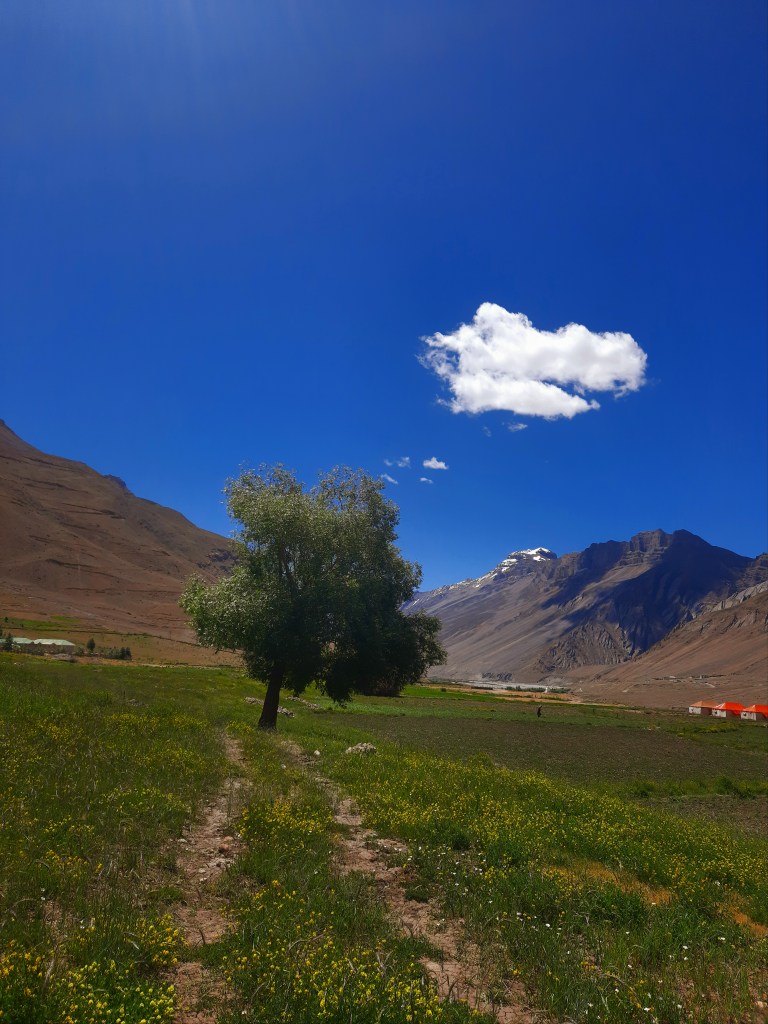
It’s been two years since my visit to Tashiding in Sikkim. Everytime I look back to that day, I feel grateful. And every now and then it’s important to reflect on all that one is grateful for.
Tashiding hill was visited and blessed by Guru Rinpoche in the 8th century A.D. The monastery itself was built on the site around the 17th century A.D. according to a few sources. Perched on a hilltop, Tashiding monastery is a blessed treasure. The road goes upto a certain extent, after which one has to walk on a beautiful stepped path leading to the monastery. On the day I visited, the sky was clear and beautiful. We made our prayers at the various lakhangs. Then, one of the monks conducted prayers for us and then we made kora (circumambulations) around the monastery premises. We also paid our respects to the rock where Yeshe Tsogyal, one of Guru Rinpoche’s primary students, had meditated.
Losar is the new year celebration in most parts of Kinnaur and Himalayan regions where there is an influence of Himalayan Buddhism. Losar breaks up into two words ‘Lo’ (Year) and ‘Sar’ (New). Every year it is celebrated according to the Tibetan calendar so it doesn’t fall on the 1st of January. The dates vary even amongst the regions that celebrate Losar.
In Kinnaur region, the Losar of Lippa is the most famous one; this year their losar was celebrated from 24th to 26th December. People from nearby places come to enjoy the three-day grand celebrations. Lippa is one of the biggest villages of Kinnaur. While travelling, we have to take a diversion from Akpa or Kiran Nallah on the National Highway 505. The village is a bit remote and reaching there is a task. The whole village is situated on a steep mountain, with a river flowing right below the village.
When I first reached Srinagar, I did not expect my relatives to suggest a visit to a monastery. Most historical narratives do not talk about Buddhist archaelogical sites in Kashmir. As part of the itinerary for the first day, we decided to see the Harwan garden and Harwan monastery. Harwan is a village near Srinagar, about 21 kms away from the city. Harwan garden is quite similar to other gardens, the dam stretching towards Dachigam. On our way back, we began our journey to the monastery.
The journey to the monastery was difficult to navigate; we had to keep an eye on a small green-colored signboard that indicated the direction to the monastery. We parked our vehicle inside a narrow pathway which led to residences and shops in the area. The monastery, as I came to know later, was up on a mountain hidden like a gem. What we saw was not just a monastery or the ruins of the monastery as I would later know but ruins of a chaitya, a structure that we deemed as a residence, and a stupa like structure. In order to reach the first part of the site i.e. the ruins of chaitya, residence, and stupa like structure, we had to climb some 200 steps/stairs. While climbing the stairs and then turning my back to look at the majestic mountains, we could clearly understand why the monks had chosen the place as their abode of living and enlightenment. We could hear the birds chirping, the wind gushing, and the chinar leaves holding their spirit still as the leaves rustled. What a perfect place to meditate! What an immense pleasure it was to revel in that silence!
“No Childik rang ache pula sum”-Brother Childik and his three sisters
It is probably my favourite tale, which was often narrated by my grandparents during my childhood before going to sleep. It always starts with the sentence, “Ache pula sum la no chichik yotuk” i.e. three sisters had a younger brother named Childik.
Childik is a very unusual name as no one in our region has such a name. I am not sure if this name has any meaning. Maybe errors in oral traditions over several generations resulted in a name like Childik, or maybe it’s a word that we lost over the generations. Although there is a word “Chikdil” in Bhoti language that means unity.
The pictures in this photo essay could possibly depict the myriad microcosms inhabited by different beings within the world of Leh Main Market area. Since I hadn’t taken these with the intention of later turning them into a photo essay, would it perhaps be okay to say that there is a somewhat natural element to the pictures’ composition? A somewhat natural element that wouldn’t have been captured if not for the mobility facilitated by new media.
Two boys, one on roller skates and the other one with a skateboard .
Anyone who has been to Leh Main Market will know that the little kids who live in the area make the market their playground: playing football, cycling, skateboarding and roller skating. Skateboarding has really taken off in Leh. In a span of a few years, I have noticed an increasing number of skateboarders. This year, I also spotted many roller-skaters; could this be a convenient way to keep ice-skating skills intact? In Ladakh, during the winters, all water bodies get completely frozen: forming natural ice skating arenas. Hence, many take to the winter sport; however, since ice-skates are expensive, not many can afford the sport.
There are times when I feel that I do not have a right to speak about my valley. After all, I have half a parentage from there. Since childhood, my sister and I have constantly juggled between identities that our multi-ethnic selves reflected in our facial features and body languages. If the places in which we lived commented on our not-so mainlandish features, our hometowns considered us the opposite. We looked quite different even from them. As the looks would always be an issue, I guess my family members tried looking at it from a different perspective. Instead of eyes, they would comment on how my hair resembled my aane’s. Instead of the tone of the skin, they would tell me that I behaved exactly like a Lahauli. Although I used to take these matters seriously, it’s only on reflection that I realize these were rueful complements to make me feel a part of the family, of the larger community.
World environment day. I don’t know about the world, but climate change sure feels all too real in Ladakh. Those from other trans-Himalayan regions too seem to be finding this summer cooler than usual. We held a public poll on our Rewa Sum story asking whether ‘Trans-Himalayan summer feels cooler than usual?’ this year and the above picture demonstrates what the 18 respondents had to say. Besides everyone in Ladakh seems to be talking about how unusually cool this summer is. A fact highlighted by the inconsistent opening and closing of mountain passes in the region.
Marriage is one of the most important institutions of any civilisation. It acts as the base of many societies. Various societies have their own rituals and customs for marriage.
And over time, the rituals and customs have evolved. In the old days, Kinnauri weddings used to happen for 4 days. But due to time constraints and other unknown reasons, marriages have now become just a 2 day event.
I still remember the times when the arrival of Buchen to our village was an annual event. Every year they would appear in the winter months, when all the villagers were done with their farm work and were about to go into resting mode, and then after days of performances, Buchen would disappear for the rest of the year. I remember the Buchen who would go to different villages one after another spreading religious knowledge in dramatic and witty ways.
On 28th November 2022, The Administration of the Union Territory of Ladakh Revenue Department released a document : ‘Inviting objections from the general public to the draft “The Union territory of Ladakh Right to Fair Compensation and Transparency in Land Acquisition, Rehabilitation and Resettlement (Social Impact Assesment and Consent) Rules, 2022.
I have many objections. The first being, despite being guaranteed the Sixth Schedule by the Constitution of this country as a region comprised of 97% members belonging to the Scheduled Tribe, we have so far heard nothing about our land safeguards. Instead here we are having to look at schemes that are opening doors for land acquisition instead. Slow claps.
Himachal Pradesh will be casting its vote for the general election of the state assembly this month. I have very little and narrow knowledge regarding the working of election on the ground. Whatever I know regarding it is what I learnt in school and books. We are taught that India is a democratic republic, which meant that people exercising their right to vote will choose their representatives. But it took me years to understand the depth of it. The right to vote is an extraordinary power granted by our constitution. This power was first exercised by eligible voters of India in the election to the first general assembly but it took few more years for people in Spiti to exercise this right. i.e. in the year 1956 in the elections to second general assembly.