By Rinchen Angmo
Someday we’ll stand in front of Singey Khababs (River Indus),
It’ll be a witness to us,
To our hopes and dreams,
To our tears and screams,
By Rinchen Angmo
Someday we’ll stand in front of Singey Khababs (River Indus),
It’ll be a witness to us,
To our hopes and dreams,
To our tears and screams,
By Lungmying Lepcha
“Put yourself behind my eyes and see me as I see myself, for I have chosen to dwell in a place you cannot see “ -Rumi
I used to think that aamik (translated as eyes in Lepcha) is the only way one can perceive life. Aamik in Lepcha means eyes. It is an impactful word among my family members who mostly wear glasses for better vision. I believe it is with the aamik that we are able to peer at the world.
Read moreBy Manya Ohri
Read moreWritten by Lungmying Lepcha
the cold
crisp
winds
from the breath of the mountain
knocks through my table and to my ear
to wake me up
from the still sleep I occupy
in the afternoon sun ,
By Lhundup Gyalpo
Picture this: An alpine desert forest is yet to receive its share of rain. For now, all it boasts of is an overgrowth of shrubs and thorns; dull, prickly, and urgently jostling for every nook of the forest. In a busy yet insipid corner of the parched forest, a yellow dandelion blooms silently, perky yet serene, pleasing to watch, and assuredly present.
Read moreBy Lhundup Gyalpo
Buddha Purnima, the full moon day of the 4th month of the lunar Calendar, is celebrated as the birth, enlightenment and passing away of the Lord Buddha. Of the many celebratory events that mark the day, one, in particular, is peculiar to Ladakh; the procession of Buddha’s scriptures. People carry thick and heavy volumes, usually wrapped in saffron cloth, over their heads and shoulders and tread across the rugged expanse of Leh town for almost a whole day!
Read moreBy Lhundup Gyalpo
A bunch of yellow and listless leaves rustled in a small eddy by the closed door. The wind blew in a melancholic whirl, whistling in a doleful hum. Nine thirty-two in the morning, the house was still dimly lit, bereft of light; a thick overcast kept the sun away in its sombre folds.
Read moreBy Priya Srivastava
Read moreBy Gauri Sharma
Read moreWritten by Divya Sharma
Read moreBy Shreyansh Pradhan

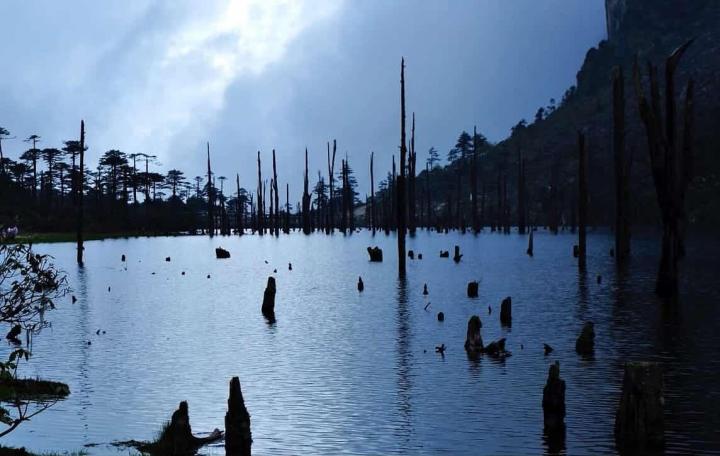
Written by Rinchen Angmo
Rainbow body. What could it possibly mean? I had often come across this term, without being able to fathom how one could logistically turn into a rainbow body. I’m no closer than I was, but I suppose I have given it some thought. After all, if we look close enough, we’re bound to notice the creation of rainbows in our everyday experience of the light and sound show called life.
Different schools of Tibetan Buddhism have their own terminology to express the Buddhist notion of emptiness. From what I understand, the Nyingma school expresses it in the form of a rainbow body.
Read moreWritten by Lungmying Lepcha
A brief analysis of the appearance of the Tibetan national flag in the song “Sadda Haq”.
Rockstar by Imtiaz Ali still remains a classic amongst all the cinephiles. We declare it the Indian or rather better version of Romeo and Juliet .
Read more