Pangong Tso is so much more than a water body, it is a living remnant of natural history.
Anyone who’s been to Pangong Tso will testify to it’s limitless beauty. Glittering amidst snow capped mountains, the water body is one of its kinds. Different hues of blue adorn it’s large expanse.
Pangong Tso is not only a beautiful water body but also a living remnant of natural history. According to geography, the Tethys sea was an ancient water body that existed in this part of the world. As the two continents collided to give rise to the Himalayas, the sea was subsumed, except some bits of it which remained as lakes. Other theories trace the origin of high altitude lakes to later tectonic activities. Either way, lakes like Pangong Tso in the Trans-Himalayas are living remnants of natural history.
Spid is the closest possible translation of spring in Ladakhi, yet the aura that the word carries is markedly different. The word spring has this feeling of freshness. Yet when I think of the word for spring in Ladakhi, that is spid, it reminds me of the windy days in April and of course apricot blossoms. According to my Abile (granny) spid aligns with the first three months of our traditional calendar. Typically, spid is characterised by strong winds known as spid lungs or spring winds. Hence, the Ladakhi image of spring is quite different from the one that is conjured by the English word.
It’s been two years since my visit to Tashiding in Sikkim. Everytime I look back to that day, I feel grateful. And every now and then it’s important to reflect on all that one is grateful for.
Tashiding hill was visited and blessed by Guru Rinpoche in the 8th century A.D. The monastery itself was built on the site around the 17th century A.D. according to a few sources. Perched on a hilltop, Tashiding monastery is a blessed treasure. The road goes upto a certain extent, after which one has to walk on a beautiful stepped path leading to the monastery. On the day I visited, the sky was clear and beautiful. We made our prayers at the various lakhangs. Then, one of the monks conducted prayers for us and then we made kora (circumambulations) around the monastery premises. We also paid our respects to the rock where Yeshe Tsogyal, one of Guru Rinpoche’s primary students, had meditated.
My family friends came to meet us a day after the beginning of the Tibetan New Year and Fagli, the new year celebrated by the people of the Pattan Valley in Lahaul. They were cheery and happy like always. They told me how they used to spend their winter days in Lahaul as children. It started from their school days and ended up discussing the pack of young boys who used to take notice of the shepherds from Zanskar and use their donkeys to ride in the fields. From picking apples from a neighbor’s farm to playing with a bow and arrow in the field, they concluded: “You have never experienced this joy in the cities.” I agreed with her since our city life was almost devoid of the community and nature that Lahual offered. In the next few silent minutes, my aunt finally asked me about my meeting with Jetsunma. She later revealed how she met Jetsunma Palmo. Her first meeting was surprisingly in that same cave that Jetsunma had resided in. She had gone on one of her expeditions with her father to the jungle. One day, as she was the youngest in that expedition, she was sent to her to ask for some salt. The first meeting was the simple act of getting salt from Jetsunma. The second time she met her was at a function organized by some monks from Kinnaur. At a random book collection for her daughter at Capital Book Depot in Chandigarh, she came across a book with a cover image of someone she knew. On further notice, she recognized Jetsunma Tenzin Palmo in her first book. Her meetings with her happened by chance as if fate was just unveiling itself as she opened one door to another.
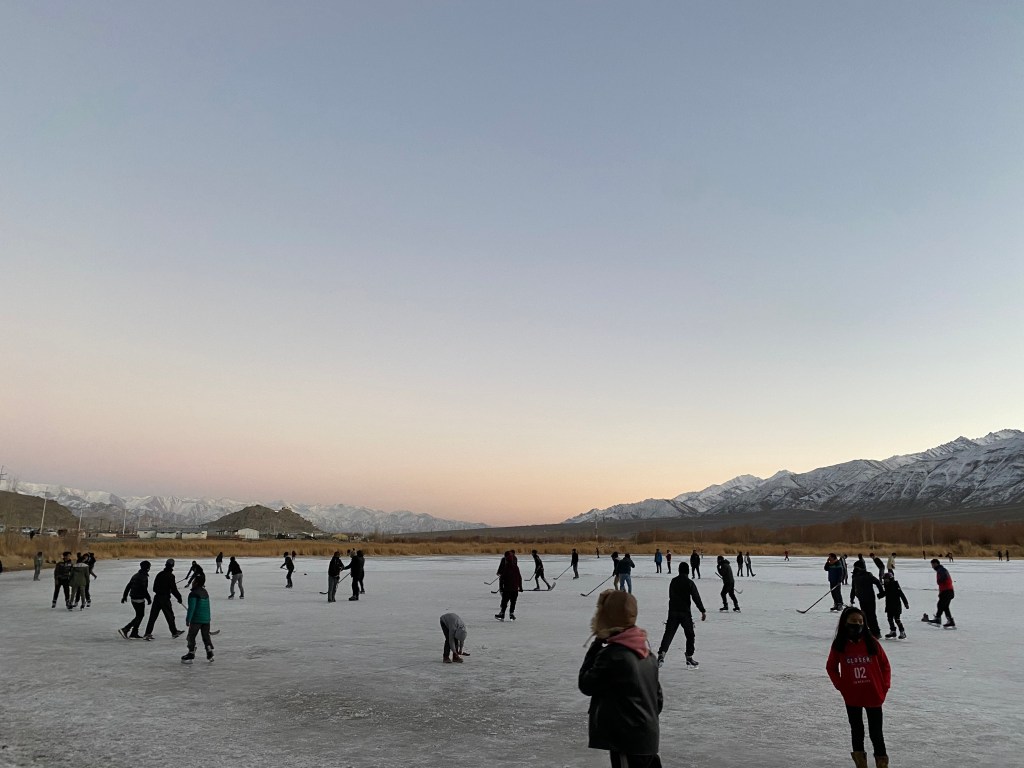
Of the few complete winters I have spent in Ladakh, in the winter of 2020-2021 I finally tried ice skating. When I was younger, I’d often been envious of ice skaters; back then, Karzu zing was the ice skating hub of Leh.
Winter in Ladakh can get dreary, but for many young Ladakhis ice skating has been quite the winter activity. However, since ice skates are expensive, it is not an activity that many can afford.
Ice skaters in Leh, January 2021.
Many years back, when I came across Auden’s “Musée des Beaux Arts” I looked up the associated paintings and somehow Pieter Bruegel’s depiction of ice skaters really reminded me of the ice skating scene in Leh. I’m not sure whether or not the figures in his paintings don modern ice skates; regardless, the connection remains, because even before modern ice skates arrived in Ladakh, activities on ice like “sikiting”-skating on a small sledge like structure- were prevalent. So, it’s the overall ethos of the portion of the paintings which depict ice skating which resonated with me.
Losar is the new year celebration in most parts of Kinnaur and Himalayan regions where there is an influence of Himalayan Buddhism. Losar breaks up into two words ‘Lo’ (Year) and ‘Sar’ (New). Every year it is celebrated according to the Tibetan calendar so it doesn’t fall on the 1st of January. The dates vary even amongst the regions that celebrate Losar.
In Kinnaur region, the Losar of Lippa is the most famous one; this year their losar was celebrated from 24th to 26th December. People from nearby places come to enjoy the three-day grand celebrations. Lippa is one of the biggest villages of Kinnaur. While travelling, we have to take a diversion from Akpa or Kiran Nallah on the National Highway 505. The village is a bit remote and reaching there is a task. The whole village is situated on a steep mountain, with a river flowing right below the village.
When I first reached Srinagar, I did not expect my relatives to suggest a visit to a monastery. Most historical narratives do not talk about Buddhist archaelogical sites in Kashmir. As part of the itinerary for the first day, we decided to see the Harwan garden and Harwan monastery. Harwan is a village near Srinagar, about 21 kms away from the city. Harwan garden is quite similar to other gardens, the dam stretching towards Dachigam. On our way back, we began our journey to the monastery.
The journey to the monastery was difficult to navigate; we had to keep an eye on a small green-colored signboard that indicated the direction to the monastery. We parked our vehicle inside a narrow pathway which led to residences and shops in the area. The monastery, as I came to know later, was up on a mountain hidden like a gem. What we saw was not just a monastery or the ruins of the monastery as I would later know but ruins of a chaitya, a structure that we deemed as a residence, and a stupa like structure. In order to reach the first part of the site i.e. the ruins of chaitya, residence, and stupa like structure, we had to climb some 200 steps/stairs. While climbing the stairs and then turning my back to look at the majestic mountains, we could clearly understand why the monks had chosen the place as their abode of living and enlightenment. We could hear the birds chirping, the wind gushing, and the chinar leaves holding their spirit still as the leaves rustled. What a perfect place to meditate! What an immense pleasure it was to revel in that silence!
Nas, the food associated root of my existence. The Ladakhi word for barley is nas. For centuries, the people of Ladakh, Tibet, Spiti, Lahaul and various places across the Trans-Himalayas have cultivated barley. In most parts of the aforementioned places, a barley based dish called kholak/tsampa has from time immemorial been a staple diet.
Though I don’t eat kholak as often as I would like to, the dish inevitably becomes a symbol of the root of my food associated existence. I say food associated specifically, because there are various other ways of quantifying roots of existence in different tangible and philosophical spheres.
As I recall, it’s a story of five birds. But a friend of mine insisted that there were more than five birds, however even she wasn’t clear about the details. So this story will be about the tale of 5 birds.
Like all other folktales from Spiti, this too starts with the sentence ” yoyo metuk”- I don’t know what this means but every folktale starts with this sentence followed by “yul jaga chenmo na” -( in a big village). And then the story follows.
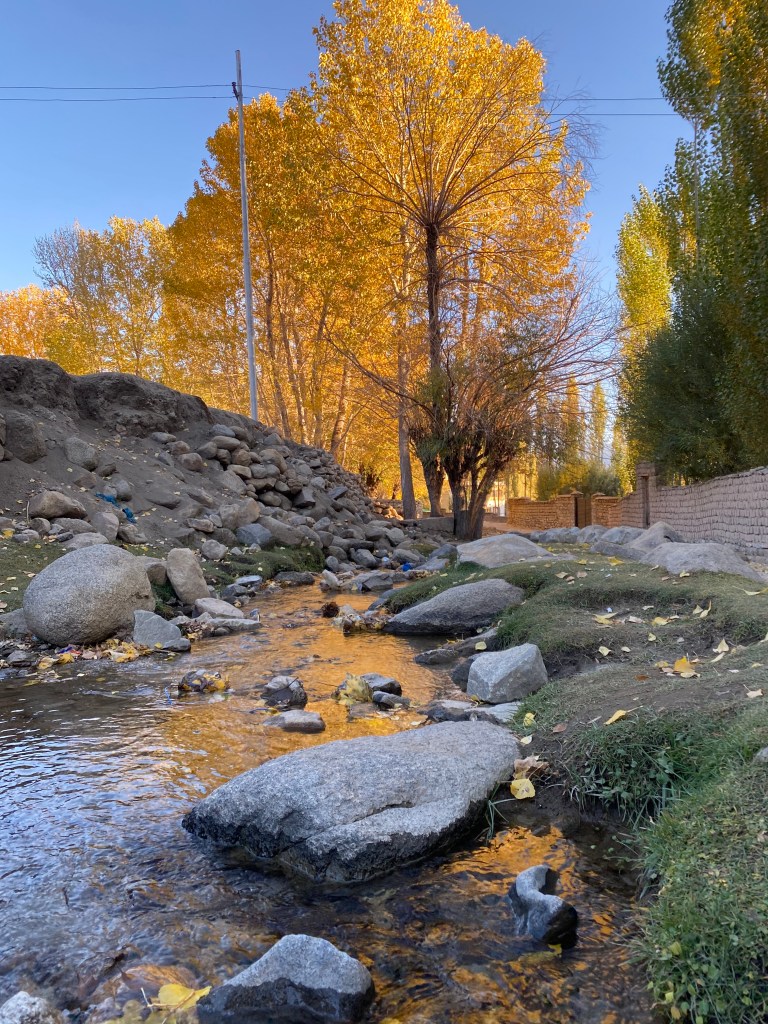
Seasons, they come and go, just like the thoughts in my mind. Even feelings come and go, but they stay a while longer than thoughts do. Yellow leaves, do they make me think of different songs?
Somehow even when I’m not in my homeland, my mind invariably registers different months vis-à-vis the seasons of my homeland. May, there will be apricot blossoms in Ladakh; June, the weather in Ladakh will be pleasant; October, the leaves will turn yellow; December, it will be very cold in Ladakh. That’s why no matter where I am, my mind always understands different months through the lens of the different seasons of Ladakh.
“No Childik rang ache pula sum”-Brother Childik and his three sisters
It is probably my favourite tale, which was often narrated by my grandparents during my childhood before going to sleep. It always starts with the sentence, “Ache pula sum la no chichik yotuk” i.e. three sisters had a younger brother named Childik.
Childik is a very unusual name as no one in our region has such a name. I am not sure if this name has any meaning. Maybe errors in oral traditions over several generations resulted in a name like Childik, or maybe it’s a word that we lost over the generations. Although there is a word “Chikdil” in Bhoti language that means unity.