Written and photographed by Rinchen Angmo
Of the few complete winters I have spent in Ladakh, in the winter of 2020-2021 I finally tried ice skating. When I was younger, I’d often been envious of ice skaters; back then, Karzu zing was the ice skating hub of Leh.
Winter in Ladakh can get dreary, but for many young Ladakhis ice skating has been quite the winter activity. However, since ice skates are expensive, it is not an activity that many can afford.
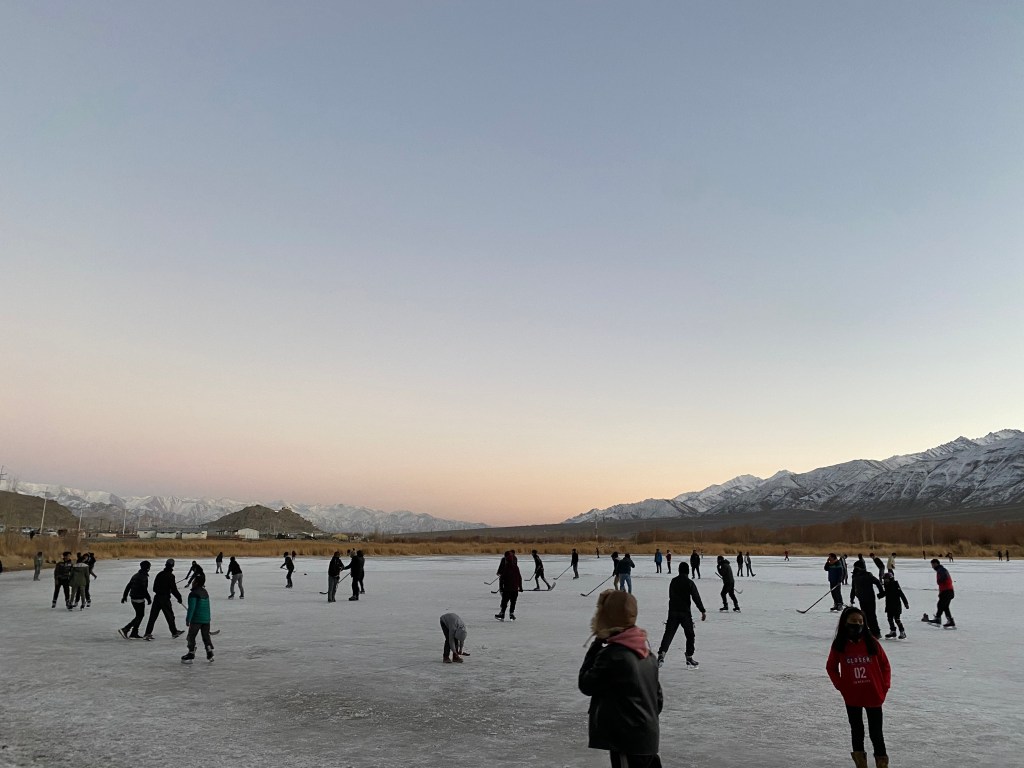
Many years back, when I came across Auden’s “Musée des Beaux Arts” I looked up the associated paintings and somehow Pieter Bruegel’s depiction of ice skaters really reminded me of the ice skating scene in Leh. I’m not sure whether or not the figures in his paintings don modern ice skates; regardless, the connection remains, because even before modern ice skates arrived in Ladakh, activities on ice like “sikiting”-skating on a small sledge like structure- were prevalent. So, it’s the overall ethos of the portion of the paintings which depict ice skating which resonated with me.
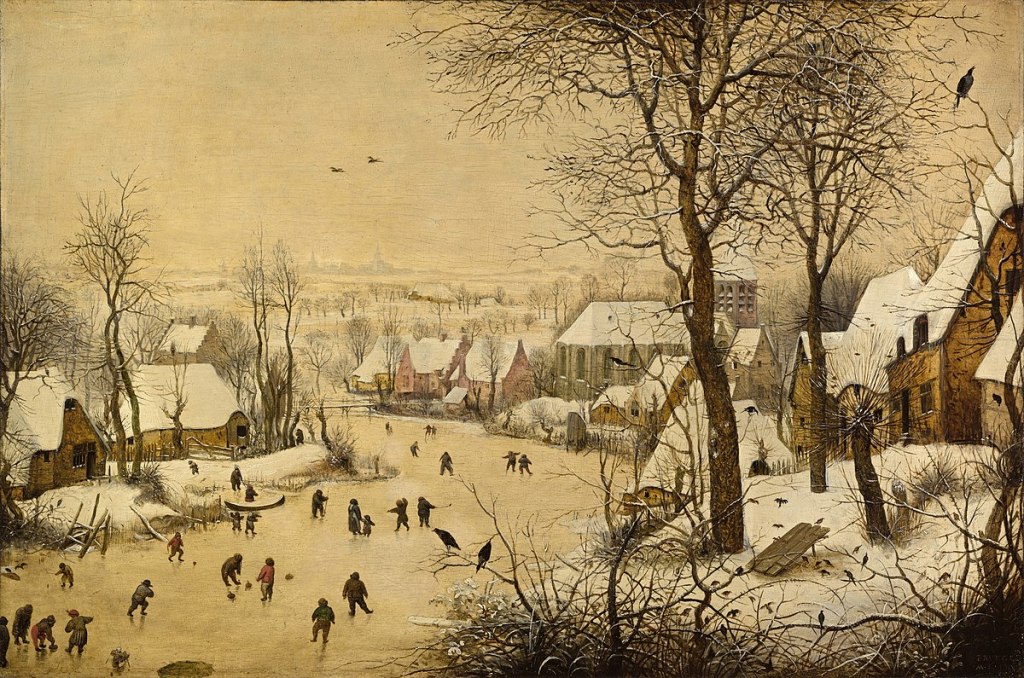
While writing this article I revisited a few of Bruegel’s paintings online to refresh my memory. No sooner had I seen them than I understood why the paintings would have reminded me of ice skating scenes from Leh. Like Leh, the locales in the paintings have naturally formed ice. The cold, the impression of people enjoying this winter activity, and the emotions hence conveyed so acutely aligned with my impression of ice skating in Leh that for a moment it didn’t matter that this scene came from Europe. Perhaps, it was my attempt to relate references from my education to my homeland; perhaps, I had looked for a way to connect my privileged yet distant boarding school curriculum to my homeland. Anyhow, I remember having enjoyed reading the poem and viewing the paintings online.

I only skated for about 12 days at Dolma Lake/Gupuks in January 2021, but it was worth the while. For the first few days, i would incessantly fall flat on the ice. To be honest, as a twenty something year old, it was quite embarrassing to fall in front of strangers. But it was really fun. And more than that, it was a truly beautiful experience. I remember once one segment of the lake’s ice had been freshly smoothened, making it more slippery than usual. A few of the younger kids who knew I was a new skater, rushed to inform me of this and held my hand as they told me to carefully step onto the ice. I was really impressed with this gracious behaviour stemming from 6-7 year olds, a characteristic that I have noticed in many Ladakhi kids; and I can only hope that they continue to be raised the same way.
Once I caught a hang of the activity, I was able to circle around the lake comfortably. And what a beautiful feeling that was, to skate on naturally formed ice surrounded by snow capped mountains. It would feel like the world reeled around you as you skated your way through life.
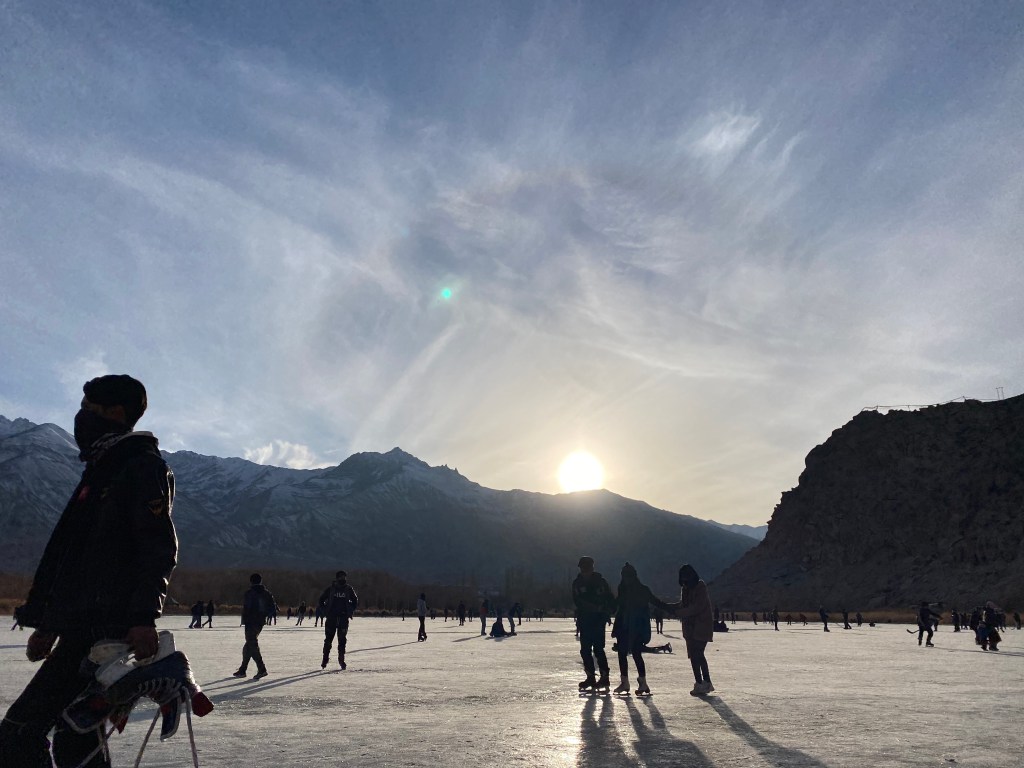
But, humans are not the only stake holders of naturally formed ice, one has to be mindful of how the area is maintained so that when the ice turns to water in the summers, the lake’s migratory ducks will find their summer abode in good condition.
Ice skating takes place in other parts of Ladakh and the Trans-Himalayas as well, but I only know somewhat about how it unfolds in Leh.
With climate change, one is compelled to wonder as to how many more winters these lakes will continue to freeze. Likewise, one cannot help but wonder how long the glaciers, year round snow capped mountains and the rivers arising from them will remain. Hence, active climate change mitigation efforts are essential to say the least.
There are so many sides to this activity of ice skating on naturally formed ice. For some it is a sport, for some leisure, for some an activity and for some an escape. Here, I must mention that most of the members of ice skating teams representing India comprise Ladakhis and many have gone on to win accolades at international tournaments; a feat considering the lack of adequate facilities.
As for me ice skating was an escape. An escape during 2020-2021 winters. Maybe that’s why I keep coming back to the scene from Bruegel’s paintings. After all, the skaters in the paintings and the ones in Leh are similar in the sense that in those few hours of iceskating they are somewhat oblivious to the world around them; or perhaps it is an oblivion sought out to find an escape. So somehow this European painting has something in it for me to relate to my Trans-Himalayan town; and maybe one is always trying to find shared experiences in life and in art.
Please note: do not take this as a source of motivation for flying to Leh to ice skate. Leh is situated at a very high altitude and therefore, pursuing an activity or sport there requires a minimum one month of stay to properly acclimatise. By now the ice would not be strong enough to skate on, so there’s no point anyway.
