Written and photographed by Sonam Chhomo

When I first reached Srinagar, I did not expect my relatives to suggest a visit to a monastery. Most historical narratives do not talk about Buddhist archaelogical sites in Kashmir. As part of the itinerary for the first day, we decided to see the Harwan garden and Harwan monastery. Harwan is a village near Srinagar, about 21 kms away from the city. Harwan garden is quite similar to other gardens, the dam stretching towards Dachigam. On our way back, we began our journey to the monastery.
The journey to the monastery was difficult to navigate; we had to keep an eye on a small green-colored signboard that indicated the direction to the monastery. We parked our vehicle inside a narrow pathway which led to residences and shops in the area. The monastery, as I came to know later, was up on a mountain hidden like a gem. What we saw was not just a monastery or the ruins of the monastery as I would later know but ruins of a chaitya, a structure that we deemed as a residence, and a stupa like structure. In order to reach the first part of the site i.e. the ruins of chaitya, residence, and stupa like structure, we had to climb some 200 steps/stairs. While climbing the stairs and then turning my back to look at the majestic mountains, we could clearly understand why the monks had chosen the place as their abode of living and enlightenment. We could hear the birds chirping, the wind gushing, and the chinar leaves holding their spirit still as the leaves rustled. What a perfect place to meditate! What an immense pleasure it was to revel in that silence!

We visited each and every ruin. The most interesting aspect of the ruins was the material- pebbles- used in order to create those structures. There must have been some limecast that was used by the archaelogists too in order to recover the ruins.
When we reached the stupa like structure, my relative told me something- the elders from our place consider such sites as sacred referring to the land especially the soil on which the ruins/structures are constructed. The elders often take a small amount of the soil and carry it with them to places where they want to build a house/a new home (Lahaul). While speaking these lines, she opened her purse, took out a tissue paper and used it as a holding device to keep the sacred soil intact until we reached our house/home.
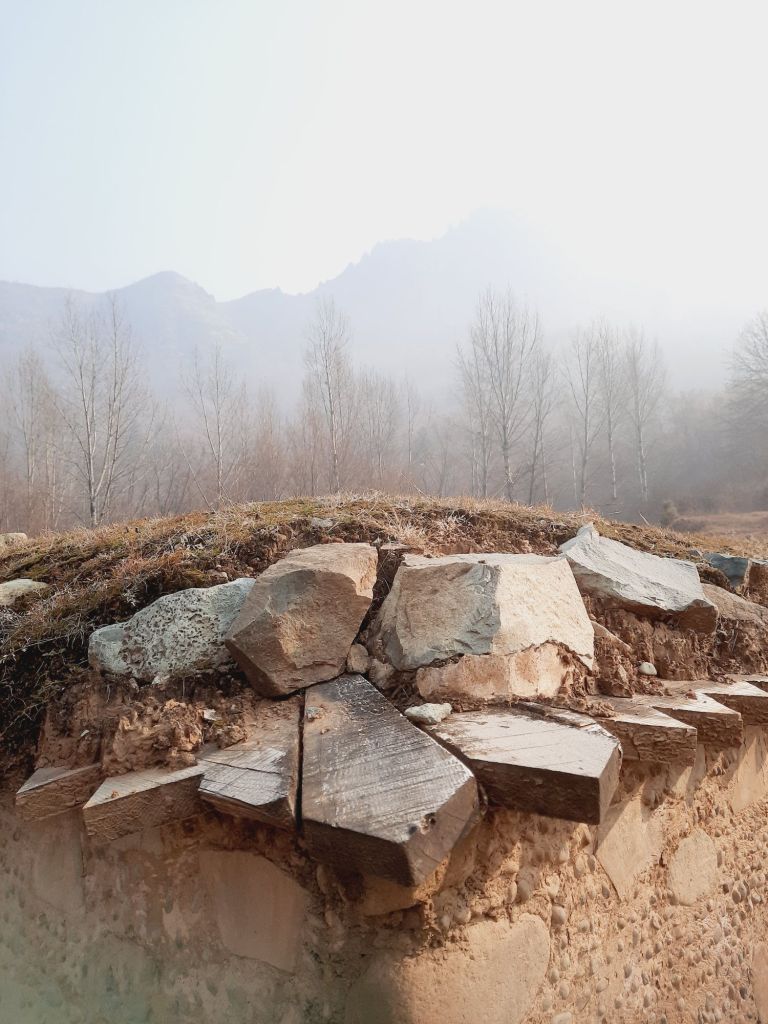
We climbed another 100 steps to reach the second part of the site, the monastery. Unlike the first part of the site which was open and filled with a few benches, this site was within barracades. We couldn’t understand the importance of barricades but my guess was the danger of wild animals because the site was near to the forests. The monastery was also made with the same materials- pebbles, stones and limecast. This structure was different from the ones we saw on the lower ground. This was bigger and required a small staircase to walk inside the ruins of the monastery. We couldn’t find any guide to tell us the details of these ruins.

It was so spectacular just to see those ruins standing right in front of my eyes. It was the very place where the famous Buddhist monk Nagarjuna resided in one of those structures. And it was the same exact place where the fourth Buddhist council of Mahayana Buddhism (organized by King Kanishka I) was held. I think, as a history buff, I was taken aback when I saw that there was noone except us to see this magnificient archaelogical place. Upon doing some research after several days of our visit, I found out that there was more to these ruins. Among the archaelogical artefacts was also found terracota clay tiles with engravings of motifs of birds, and trees, and crouched ascetic saints which is now somewhere in a museum in the Global North. The UNESCO world heritage site gives the following description of the terracota clay tiles
“These Harwan terracotta floor covering have unique place in the plastic art of India represented beautifully in the Kashmir valley for the first time. The tiles in backed clay are 18’x12” long and moulded with floral, geometrical, human and animal designs. They reflect a colourful and pulsating life style of the contemporary society.” (1)
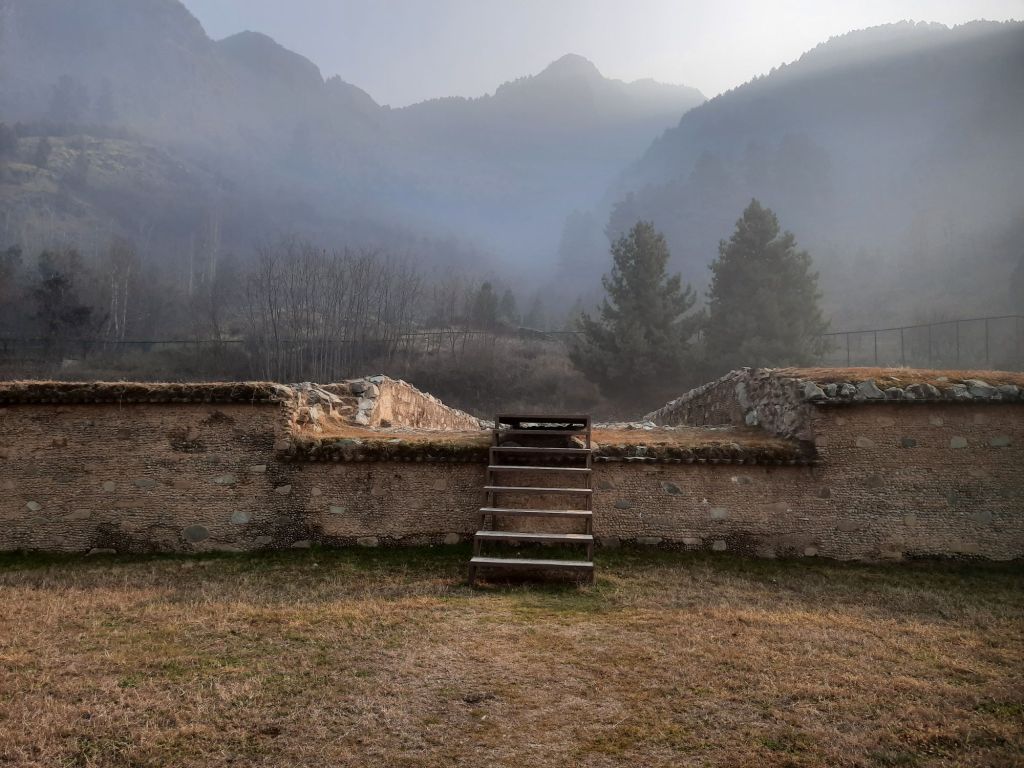
My relative who had visited this site some months ago told me that the place was usually populated with tourists from Malaysia, Japan and other countries during summer and autumn seasons. But even in peak winter and a bit of fog, we, as tourists, found the entire journey to the sacred sites worthwhile. Although the leaves of the trees were seen withering away, we still enjoyed the trek and whatever the cold wind and nearby forest had to offer to us. For my relative, visiting a sacred Buddhist site was like a pilgrimage. For a history buff like me, it was a journey towards uncovering the sacred.
To read more on the terracota clay tiles, you can read:
1.https://whc.unesco.org/en/tentativelists/5492/
2.https://archive.blogs.harvard.edu/cqtwo/2008/02/09/mysteries-of-the-east-2-the-enigma-of-harwan/
