A personal essay by Sonam C

There are times when I feel that I do not have a right to speak about my valley. After all, I have half a parentage from there. Since childhood, my sister and I have constantly juggled between identities that our multi-ethnic selves reflected in our facial features and body languages. If the places in which we lived commented on our not-so mainlandish features, our hometowns considered us the opposite. We looked quite different even from them. As the looks would always be an issue, I guess my family members tried looking at it from a different perspective. Instead of eyes, they would comment on how my hair resembled my aane’s. Instead of the tone of the skin, they would tell me that I behaved exactly like a Lahauli. Although I used to take these matters seriously, it’s only on reflection that I realize these were rueful complements to make me feel a part of the family, of the larger community.
In addition to all the above mentioned acts that we faced in our lives, there was another problem that was not just limited to us but to all those children whose parents worked in the government sector. We never really lived there. We never lived in our hometowns. We were brought up in states and districts other than our own. For us, our hometowns were more like picnic spots where we would return to every summer vacation. Traveling in winters was not possible because the roads would be blocked. Hence, summers were the only season when we would see our house, land and mountains. I don’t know about other children but there were times when thoughts of studying in a place closer to home sounded much better than living in a completely different culture/city. For years, I had this firm belief that I would have been happier if I would have lived among my community members. But I think it’s time to accept that life will not always happen according to your wishful thinking. In an excerpt that I read from a book on my region, it was quoted that people from my region say “Jo hai so hai” (It is what it is) whenever something happens. “It is what it is”- I feel like it’s an acceptance of life, of fate, of whatever sudden tragedies have occurred in your life. It is, I believe, ardently a sign of Buddhist philosophy of impermanence and acceptance among the people of this region.

During vacations, one of my informal tasks would be to watch/observe families (from outside our valley) and tourists who’d exhibit a certain affection that none of my family members expressed. When I say a certain affection, I mean the small details that automatically suggest that they are stepping into our region for the first time- when they push themselves to the back seat at seeing the mountains because they feel that the mountains might swallow them in the magnanimous entrances and exits; when their eyes would glisten at the night sky because it is the first time that they have ever seen the stars so clearly etc etc etc. The small details always give away. Perhaps, even we’ll engage in these details unexpectedly. Perhaps, the sheer number of times we’ve already done this makes us oblivious to the thrill of looking at mountains. I say even those of us who are so familiar with the roads, and their consequences on our gut health in times of motion sickness, should indulge in the thrill. Sometimes, being a tourist in your own hometown provides a fresh perspective to your experience. Sometimes, I feel envious of tourists who are able to strike a chord with us. They say that it’s a once in a lifetime opportunity to see the mountains and interact with us. For the ten days that they visit our place, they make sure that they search for all nooks and corners because deep down they know that they might not get a chance to do this in their hometown or maybe next time (if there ever is a next time).
When I see them (the tourists), I engage in a habit of looking at myself in their shoes. But I know that I am not like them. I am not a tourist in my own hometown! This realization was also in part a result of my interactions with so many others like me from other parts of the country. They face the same problems but none of them have ever expressed that they feel like a tourist. Their relationship is consistent with their complex identity. More than a tourist or an outsider, I think of myself as a flaneur. A flaneur was a term coined by Baudeliare and used by Benjamin in the nineteenth century French literary circle. It was an ode to the figure of the modern man who wandered without any purpose while he casually observed people around them. Although the politics of the figure of flaneur takes root in Marxist understanding of modernity, I take note of only the ‘wandering’ aspect.
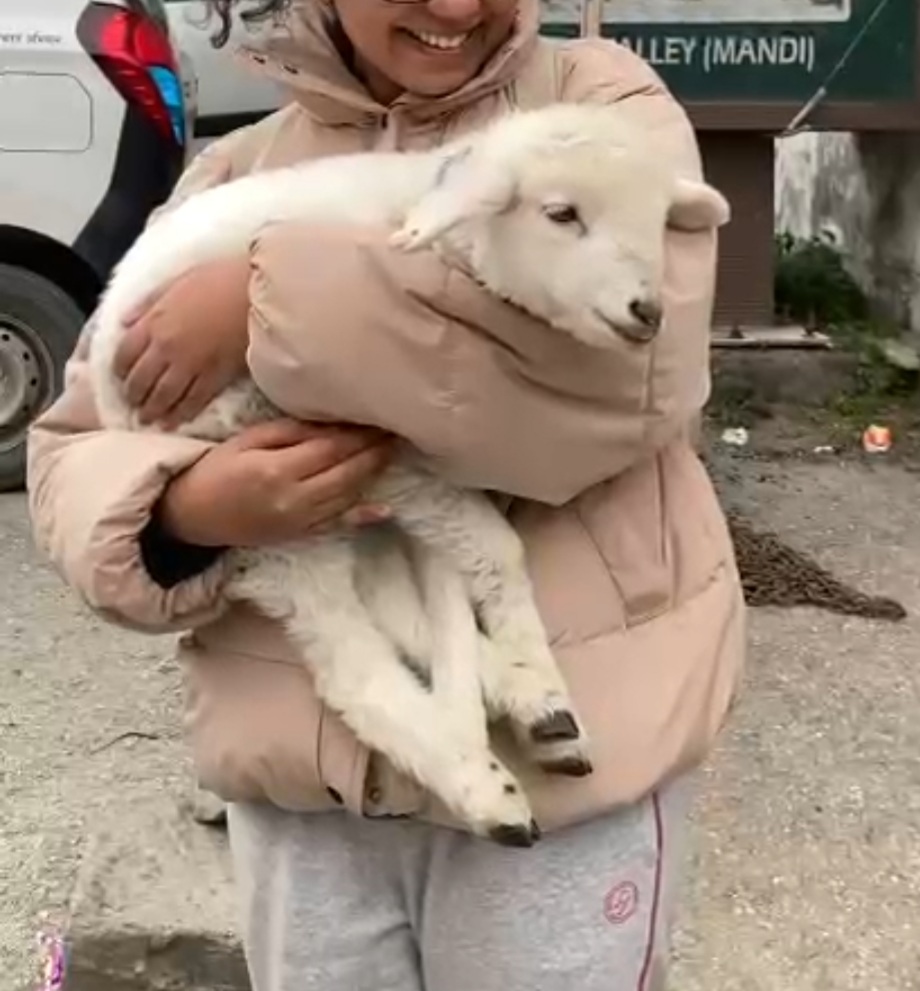
I transform into a mountain flaneur; walk the familiar lanes, buy souvenirs, search for plum blossoms, sometimes click photos with a lamb, and observe the mountains. And if this is how I negotiate my identity, my relationship with my hometown, then so be it. It is what it is.
