Written by Drishti.

It’s been fourteen days since that night when I witnessed the fields of my grandmother turn into debris. The lush green plants that used to crown those fields have now disappeared. What remains now are uprooted plants merged with soil and water flowing over them. The groundwater, surging from an overcharged aquifer, displayed a relentless determination to escape onto the Earth’s surface, washing the fields away. The night of 13th August 2023 will remain unforgettable. The fear of the unknown robbed me of sleep and caused my heart to pound. At the crack of dawn, I came out to check on the aftermath of the night. In front of my eyes lay the remains of the hard work of my guardians. Many emotions coursed through me, but the prevailing feeling was that of thankfulness for our survival. This incident had occurred when I was at my grandparents’ house near Garloni, which is about 4 km from Rewalsar town. Our phones were out of network for two days, and there was no electricity. Amid the rain, it was challenging to go out and find a spot with good network. But the urge to talk to my parents and loved ones kept me going out frequently. An old radio of my grandfather’s found a purpose after years of neglect; the news bulletin informed us that the situation in other places was much worse.
Mandi, Shimla, Kangra, Sirmaur, and other regions in Himachal faced this havoc. All these regions faced heavy rainfall, groundwater overflow, landslides, and/or floods. The videos and photos coming from social media told us that some people had found cracks in the walls of their houses and water leaking into them. In a few places, these landslides wiped off sheds and buildings, turning places into barren land as if no life had existed there before. Roads also got disconnected due to landslides. Across Himachal many human lives have been lost. However, the complete count of animals, especially pet animals and cattle, that are lost in this catastrophe remains unrecorded and rarely finds mention in the news.
In the villages of Himachal, the majority of individuals are self-made. Their eyes have witnessed everything, from placing brick over brick to build the home of their dreams to the moment when it all turned into debris within the blink of an eye. It’s not only four walls and a roof that are damaged, but also a lifelong collection of things and utensils, savings, grains, clothes, appliances, furniture, important documents etc. It should not be neglected that each thing in the house costs money, and there are countless things in homes that are lost when they are flooded away. One is left on the street directly from the comfort of the bed.
This kind of flooding and rise in water level is somewhat new, but mostly it is the same every year. Heavy rains occured earlier too. Roads getting damaged, mountains subsiding, and landslides are not new in Himachal. This ‘hate relationship’ with monsoons is long-term. But what is new this time is the number of people and property vulnerable to its impact. One of factors behind this is the untimely rainfall that occurred in Himachal during the pre-monsoon season. Additionally, the unfavourable impact of western disturbances in July also increased rainfall, as reported by the Indian Meteorological Department. This recharged the groundwater sources fully, which otherwise are being heavily exploited by the rising population and could not touch this mark easily.
The fertile Balh valley of District Mandi, which is near the Rewalsar region, was already flooded by 13th August. Our relatives staying there told us that water was flowing over the main roads. The night of August 13 must have been hard for everyone in different parts of Mandi and Himachal.
I too kept counting the seconds. I was at my grandparents’ house near Garloni, which is near Rewalsar town. I was trying to visualize the topography of Rewalsar, which is very unique, and what all possibilities lay if the heavy rain did not stop. Thankfully the rains did stop and no human lives were lost in Rewalsar. Rewal and Sar, where Sar is the noun for lake, combine to form the word Rewalsar. Its border is marked on one side by Maa Naina Hill, which is located at some distance from the lake. On the other side, there is a dense web of buildings. It is also known as ‘Tso Pema’ by Buddhists. Rewalsar is a holy place for both Hindus and Buddhists, who have their own separate religious beliefs. Sikhs also pay visits to a Gurudwara here, where Guru Govind Singh is once believed to have stayed. It is also known as Triveni because three different religions coexist here, and as a result, it attracts a lot of visitors. This lake is of natural origin, and its history dates from long ago. It is also fed by the seasonal natural streams from the hills that border it. The sewers from some adjacent neighbours’ homes and structures have easy and illegal access to this lake. During July and August, when the monsoon is in full swing, all these drains become active and transport everything deposited in them down to the lake, making a ghetto for the lake’s fish. The mini-zoo beside the lake saw severe floods during the rains.
Now let’s look on the other side of Rewalsar town and get to the details of the Maa Naina hill.
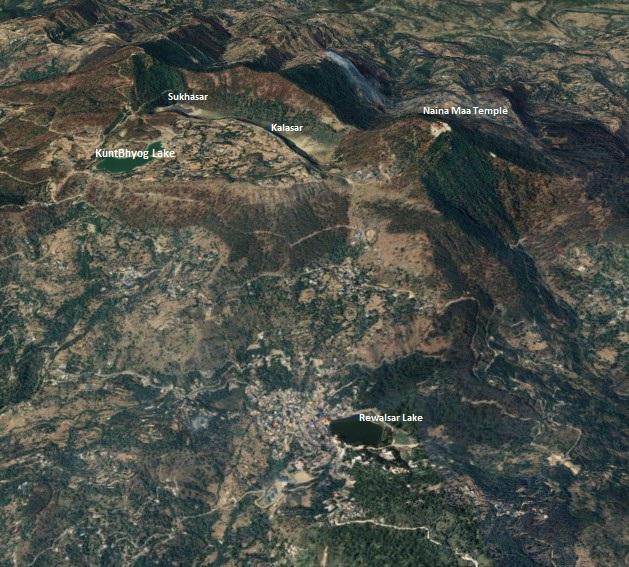
There are seven separate water reservoirs in the Maa Naina Hills, one of them is KuntBhyog Lake, which is perennial; others are Sukhasar and Kalasar, which are only operational during the monsoon. The base of Sukhasar is completely dry with cracks on it, while the base of Kalasar looks black when it is completely dry. The other four are of very small size. The small region immediately surrounding it is now heavily occupied, as is the rest of the area down the hills. This season will be remembered by the following generations because, as per locals, after roughly 100–150 years, the Sukhasar and Kalasar lakes have merged into one. That is the level of the water table at the top of this hill. What kept me awake and restless for the whole night was the fear of what might occur if the ground decided to loosen up and discharge the water of Kuntbhyog Lake down the hill. A heavy flood could have occurred, sweeping down the roads and homes of thousands of people, and whatnot. Luckily, the rain stopped, and the ground showed great resistance. The view of Maa Naina hill from my location confirmed that some water did make its way out of the hill, and it was flowing with very high intensity via its old route. Through social media, it became known that during these two-three days, people in the vicinity of Kuntbhyog lake and along its course -as it descended the hills- had left their homes. Some sought refuge in the safer homes of their relatives, while others spent the night in public spaces like halls, schools, etc. Local reporters did their best to share the ground-level situation of the affected people with everyone. Had it been one more night and day of rain, what might have followed is something I’m getting nightmares about.

Source : Facebook
It was not only this that was making my heart beat louder, but there was another aspect too. That is the topography of my location at Maa Jalpa Hill at that period of time. Maa Jalpa hill, which is separated into numerous hills below, is located close to Rewalsar town. One of its hills is known to have rich sources of water. As has happened in many places, here too, tiny reservoirs have dried up over time. But after this heavy downpour, the situation is not the same anymore. A significant volume of water has broken through a location close to the hilltop near a village named Garloni. It is streaming downward. There are only two homes down the hill. One of them is highly vulnerable to the landslide, while another, in which we are living, is safer. I was concerned because one never knows how water can alter its course or what it might cause.
Usually, it is a common belief in Himachal that the deities of the regions are protectors and guardians of their people. No doubt, administration services, the armed forces, disaster relief teams, and the government are playing pivotal roles in saving and rescuing the people, but they cannot stop the rain. However, it is believed that deities have these powers. What is in the hands of the human stakeholders in the region is to carefully manage the natural resources of the state. The state has seen massive construction for many years. Thanks to the rise in the tourism sector, hills are being peeled down to widen the road, tunnels are being dug inside the mountains, and so on.
The hilly region undoubtedly requires modernization, yet my proposal differs from what is happening in the state. More than double-lane roads on hills? No. Excessive tunnels and flyovers? No. Multi-story buildings on sloped terrain? No. Overcrowded construction? No. Unplanned buildings? No.
Strategic channelization of water and sewerage drains? Yes. Proper retaining walls with ample channels for water outflow? Yes. Build planning departments for rural areas? Yes. Free expert advice and registration of homes before construction? Yes. Strong and resilient infrastructure? Yes. Community building? Yes. A drone surveillance facility in each village, especially in the monsoon? Yes. Dividing the traffic via different routes? Yes. Sharp measures on illegal dumping and mining? Yes.
Each year, similar destruction occurs and the same relief measures are consequently implemented. Giving some lakhs of rupees after destruction won’t restore life to a completely normal state, but using that amount to ensure suitable precautionary measures will help definitely.
Author’s bio: Drishti is an ex-JNUite and belongs to Mandi, Himachal Pradesh. She deeply cares about nature and environmental conservation. She is a budding writer.
Contact info: drishtiiwrites@gmail.com
Read more articles:
The story-keeper river
By Rinchen Angmo Someday we’ll stand in front of Singey Khababs (River Indus),It’ll be a witness to us,To our hopes and dreams,To our tears and screams, It’ll take all our pain away,show us a way,be here to stay,not sway, Singey Khababs is alive with stories,about our worries,about you and me,about what’s clear to see, So…

Peering at sorrow while navigating life outside home/in hostel
By Lungmying Lepcha “Put yourself behind my eyes and see me as I see myself, for I have chosen to dwell in a place you cannot see “ -Rumi I used to think that aamik (translated as eyes in Lepcha) is the only way one can perceive life. Aamik in Lepcha means eyes. It is…
ནོར་བུ། / Gem
By Manya Ohri Photograhed by Manya Ohri A Nikon at hand shuttering pictures or a blue pen scribbling at the back of a tissue, Manya Ohri is a student of Finance who finds solace in literature and travelling. She could either be found debating on any debatable topic or being surrounded by books with her…
