By Karma Negi
I still remember the times when the arrival of Buchen to our village was an annual event. Every year they would appear in the winter months, when all the villagers were done with their farm work and were about to go into resting mode, and then after days of performances, Buchen would disappear for the rest of the year. I remember the Buchen who would go to different villages one after another spreading religious knowledge in dramatic and witty ways.
The Buchen trace their history to the great 14th century Tibetan Buddhist master Thangtong Gyalpo. They are a group of Buddhist practitioners who conduct performances based on religious tenets. But their performances are aimed not only at religious dissemination, but also at addressing socio-geographical issues. Though practised across Himalayan strongholds of Tibetan Buddhism in the past, the practice currently survives in Pin valley of Spiti alone.
In Hangrang valley (Kinnaur, Himachal Pradesh), during winters, they were the main entertainers of the masses, be it children, old people or the usual folk. They used to narrate religious stories in very dramatic ways, using local materials to create their equipments for performance. For example, horses were made using local changma wood, and monkeys out of sack and costumes were all made from local clothes; their creativity deserved special appreciation.
Everyday, by sunset, people would start gathering at a common point in the village which was decided upon by the people. The ladies would bring with them plates full of barley and dried apricots. It was mandatory for each household as it was considered auspicious, like an offering to the Buchen in return for their performances and blessings. After the completion of the rituals, they would take the offerings with them.
The Buchen performance is initiated with their Head offering prayers before an altar with their idols. Villagers also used to get involved in the initial prayers. Following this, the Buchen would start their performance .
On some days it would be stories about shepherds with their animals depicted in funny attire and with funny dialogues. On other days, it would be the story of a king and some poor fellows, where the king used to be given a beautiful horse made of sticks and clothes. On some days, the stories would be about animals; I still remember a monkey made out of sacks. In between these acts, the Head Buchen would show his extraordinary powers by piercing pins across his tongue or sometimes face.
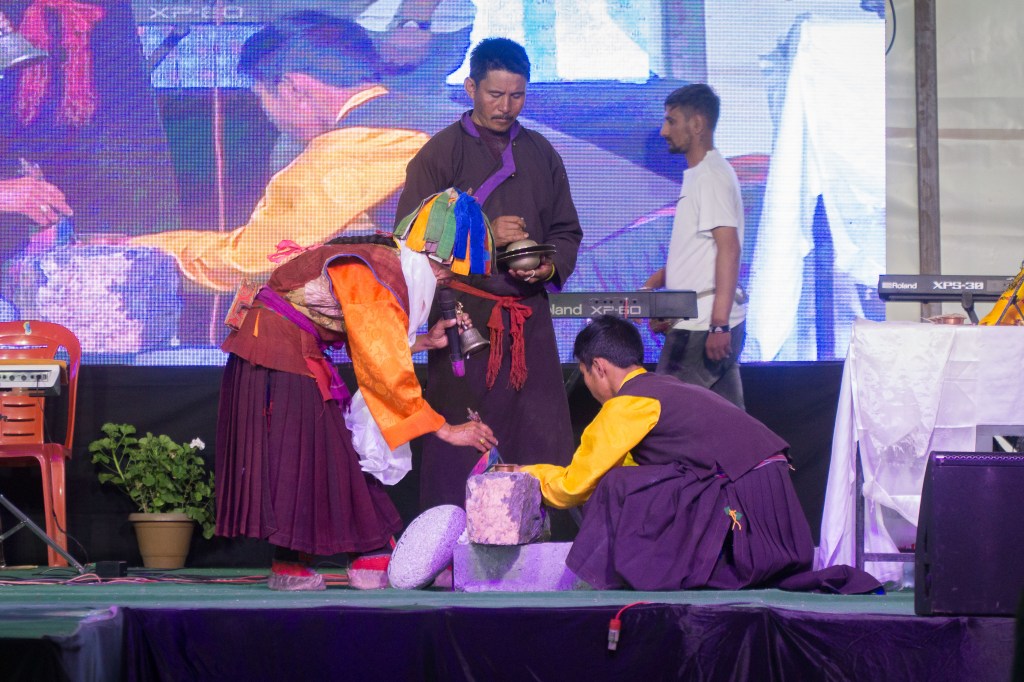
The last days used to be special when the Head Buchen would dance on swords, and after that they would perform a stone breaking ceremony, which is believed to cure chronic diseases and bring prosperity to the entire village.
Also, in the middle they used to have a day when they would make an elephant out of sticks and two of Buchen used to get inside the structure after which they would choose one kid from village who would then go on a village tour. His relatives would give him lots of money which would go to the Buchen.
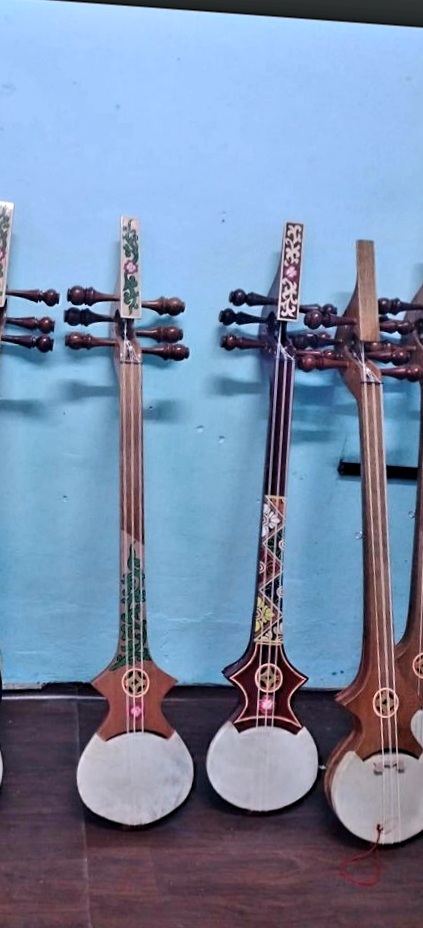
By night again some people from the village would gather at the house where the Buchen would stay. They would cook food for Buchen and would offer them wine and hospitality. The Buchen have a rich collection of old folk songs and the Head Buchen would have with him a traditional instrument called “Ghowo” (in Bhoti script གོ་བོ།), and they would sing and dance till late night everyday.
But, lately, with the arrival of TV, mobiles and other sources of entertainment, people have started giving less attention to the Buchen. As a result, with time only a few would turn up for the Buchen performances. Gradually, they just stopped coming and the Buchen culture ended in upper Kinnaur.
✒️This article is written by Karma Negi who belongs to Kinnaur, Himachal Pradesh. He is passionate about meeting new people, and learn their culture and folklores. Recently, he went to La Dharcha festival in Kaza, Spiti valley in 2022. And all his memories from childhood came flooding in which led to the production of this article.
📷The photograph captioned ‘Buchen in the stone-breaking ceremony in La Dharcha, Kaza’ is clicked by Aurélise from France.
