As a child, the question of gender inequality was quite foreign to me. Of course, I was aware of differences, but never of inequality per se.
-Rinchen Angmo
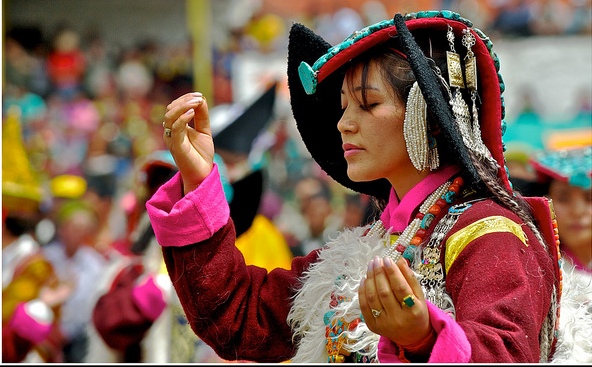
I grew up in spaces that were owned either by my maternal grandmother or by my mother. I guess this statement needs a bit of a context. In Ladakh, the system of marriage is very flexible in terms of which household the bride or the bridegroom goes to; meaning, either the bridegroom could go to the bride’s house(makpa) or vice versa(pagma). ‘Going to’ the other’s house also means assuming more responsibility over that household than your own. Both in my maternal grandmother’s and my mother’s case the bridegroom had come to their house; consequently, they received an equal share of family property. This is a common phenomenon in Ladakh and has been followed from time immemorial. In fact, even the daughters or sons who depart to another household after marriage attain a small share of family property. Hence, in Ladakh, the question of whether or not a woman can own property figures as a redundant one. Why does owning property become so important one may ask.. When one sees one’s mother or grandmother as a figure who owns property, manages it with finesse, and goes unquestioned by society, one also understands that those constructs of a-woman-can’t-handle-‘manly’-responsibilities, are after-all ‘man’-made fallacies.
I grew up in a world where there was really nothing a woman couldn’t do, and to see that a lot of the world thought otherwise was another process in itself. What I cherish most about gender equality in Ladakh is the visibility of women in every aspect of life. Be it as a petrol pump employee or as a hotel owner, one can see women everywhere. Having been to many places outside my hometown where women can seldom be seen in public or ‘male’ spaces, I realized how empowering it was to merely have women’s presence be naturalized; a realization I would have earlier considered absurd, but now digest with a pinch of salt.
Another great aspect is that the nature of interaction between men and women here is very fluid. Whether in villages or suburban spaces, men and women across all ages interact not only with a sense of candour but also with a great sense of camaraderie. The few times that I went to attend the village darsez (annual harvest festival), I noticed that women bossed around and teased the men with a complete sense of freedom; something that is seldom seen even in our ‘educated’ spaces. In fact, in olden times, the aspect of sexuality altogether was not a taboo subject. With the influence of so- called ‘modernity’, the gender lines are becoming more defined and less fluid.
These aspects of gender equality and even mutual respect can be felt in small details. For instance, my mother feels confident to drive in Ladakh despite not having the best driving skills because she knows that if she comes face to face with a car inhabited by men on a narrow road, she will not have to fear them; in fact, they will help her. Though I feel highly anxious about safety issues in public places, I know that in Ladakh my female friend and I can go out for dinner by ourselves with nothing to fear, except the fluffy and ferocious street dogs.
Nonetheless, I have to add that in the sphere of politics, women are discriminated against in Ladakh too. Though there are highly educated and accomplished women in Ladakh, the male gang of politicians in each party somehow can’t accommodate or even digest the success of female colleagues. This is something that needs to change! Likewise, how people behave in personal spaces is again subjective and needs to be regulated by individuals.
Having said that, the sense of gender equality that one experiences here is alleviating and highly empowering. Though the atmosphere so far is more or less true to our erstwhile tradition of mutual respect, one can sniff perhaps a distant danger. Hence, it is imperative that despite the influence of various patriarchal narratives, we maintain our spirit of gender equality not only for Ladakhi women but also for women from all over the world who always come back because they experience a great sense of freedom in this wonderful atmosphere.
Resisting patriarchy is a continuous process, and each one of use can make a difference. Though it may seem daunting in the face of status quo, the fact that the status quo does not translate into patriarchy everywhere should stand as an example that not only is it created but it is also dispensable.
